
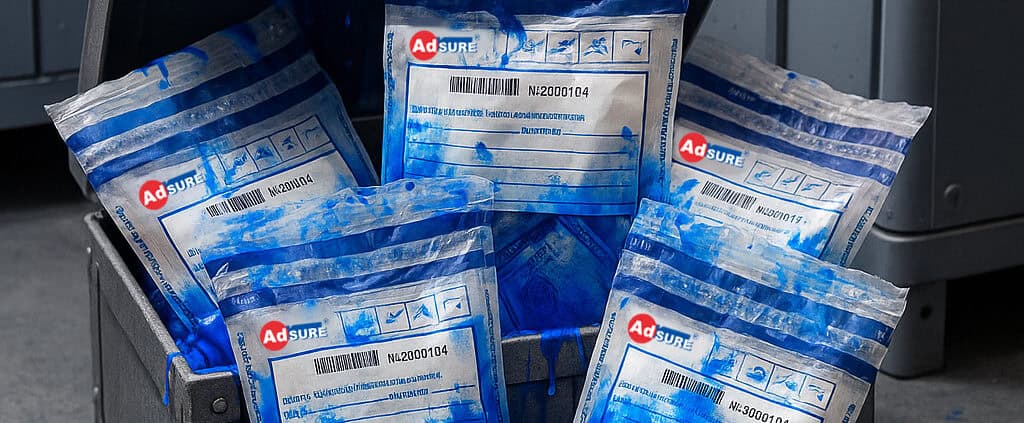
Bank Dye Packs Explained and Their Role in Cash Security
Aftermath of a bank robbery: a hidden dye pack exploded and stained a stack of $20 bills, forcing the loot to be abandoned on the sidewalk.
Exploding dye packs are a time-tested security device that banks use to thwart robbers by literally staining stolen cash and criminals red-handed. These devices remain widely used in financial institutions and cash transport, quietly protecting currency without the need for violent confrontation. In this article, we’ll explain how exploding dye packs work, discuss where and how authorized organizations obtain them, and examine their use in bank robbery scenarios. Real-world examples and best-practice takeaways will help security professionals understand the value and considerations of dye pack systems.
How Do Exploding Dye Packs Work?
Dye packs are ingeniously engineered to activate after a robbery and ruin a thief’s plans. They consist of a radio-controlled incendiary device hidden inside what looks like a normal stack of banknotes. Below is a step-by-step look at the mechanism of a typical bank dye pack:
-
Disguised within Currency: The dye pack is concealed in a hollowed-out stack of real bills (commonly $10 or $20 notes) so it appears and feels like an ordinary bundle of cash. Modern dye packs are built in thin, flexible housings that make them virtually indistinguishable from real currency, unlike older rigid models that savvy criminals could detect.
-
“Safe” Mode at the Teller: Banks keep the prepared dye-pack bundle at teller stations on a special magnetic plate. While on this plate, the dye pack’s electronics remain in an inert standby mode. During a robbery, a trained teller will surreptitiously include the dye-pack bundle among the cash handed over to the robber. As soon as the pack leaves the magnetic plate, it arms itself via its internal receiver.
-
Activation Trigger and Timing: A radio transmitter—usually concealed at the bank’s exit doors—emits a signal when the robber passes through. Upon receiving this signal, the dye pack’s timer starts counting down a preset delay (often about 10 seconds or more). This delay is intentional, giving the robber time to move a safe distance from the bank (often into their getaway car) before activation.
-
Explosive Dye Release: After the brief delay, the dye pack explodes inside the money bag. The device bursts open and ejects a cloud of brightly colored dye and smoke (typically red dye) in an aerosol form. The most commonly used dye is 1-methylaminoanthraquinone, also known as Disperse Red 9, which produces an indelible red stain. Along with the dye, many packs also release a tear gas or irritant (such as CS gas) to disorient the thief. The explosion can reach temperatures of around 200 °C (400 °F), which not only helps spread the dye but also discourages the robber from touching or hiding the scorching package.
-
Marking and Incapacitation: The erupting red dye permanently stains the stolen money and often the robber’s clothes, skin, and anything else in the vicinity. The sudden burst of red smoke and the possibility of tear gas typically startle the robber and may cause them to drop the cash bag immediately. By the time the thief regains composure, the money is defaced and the thief themselves may be marked (literally “painted” red) and coughing or rubbing their eyes from the irritant. In some dye packs, additional security measures like forensic tracers or adhesive bonding agents are present; these agents can glue the bills together or embed microscopic markers, further ensuring the cash is unusable and linking the criminal to the crime scene.
-
Recovery and Evidence: The primary purpose of a dye pack is to neutralize the reward of the crime and aid in apprehension. Stained banknotes are easily recognized as stolen property – financial institutions have standing procedures to flag and confiscate dye-stained money so it cannot be laundered or spent. The indelible dye is extremely difficult to remove from fabric, skin, or the bills themselves. Attempts to wash the money (for example with bleach) have been forensically analyzed, and even then the chemical byproducts can be detected by investigators. In short, once that pack explodes, the thief is left with ruined cash and incriminating stains, while the stolen money becomes traceable evidence instead of a usable haul.
By design, dye packs offer a non-lethal but effective method to spoil a robbery. They maximize the chance of recovering cash and provide unmistakable visual evidence, all without bank staff confronting the robber. As a psychological benefit, the risk of “a bag of money that blows up” serves as a deterrent – many would-be robbers are aware that over 75% of U.S. banks use dye packs in their cash drawers. This technology, invented in the 1960s, has continually improved and remains a staple of cash security today. Modern variants and related Intelligent Banknote Neutralization Systems (IBNS) extend the concept with dye or even glue in ATMs, cash transport boxes, and other cash storage, operating on the same principle of marking stolen money unusable.
Where Can I Buy Exploding Dye Packs?
If you’re imagining picking up an exploding dye pack on Amazon or at the local spy shop, think again. Authentic bank dye packs are tightly controlled security products, not consumer gadgets. These devices contain pyrotechnic and chemical components (dye and tear gas capsules), so their distribution is restricted to law enforcement, banks, and licensed security providers. Here’s what security professionals should know about sourcing dye packs:
-
Authorized Manufacturers Only: Banks and armored cash transport companies obtain dye packs directly from specialized security equipment manufacturers. One leading provider is 3SI Security Systems (formerly ICI Security Systems), which produces the widely used SecurityPac® dye pack. In fact, the SecurityPac system has been protecting cash for decades and is credited with recovering over $70 million in stolen funds and helping apprehend 7,000+ criminals over its lifetime. Other international vendors (such as Adsure Packaging Limited in Asia) supply IBNS systems for ATMs and cash-in-transit with similar ink-staining technology. These companies sell business-to-business, meaning they will only supply dye packs to verified financial institutions, security agencies, or law enforcement – not to the general public.
-
Legal and Regulatory Restrictions: In most jurisdictions, it is legal for banks and licensed entities to use dye packs as anti-theft devices, but there are regulations governing their use. The use of dye packs by private individuals (for example, booby-trapping a package against porch thieves) is generally not advisable and could be illegal or lead to liability. Explosive dye devices could be considered dangerous weapons or prohibited “booby traps” if misused by civilians. Even businesses must adhere to safety regulations – for instance, some regions might restrict deploying dye packs in crowded public areas due to the risk of staining bystanders or property. It’s important for any organization deploying dye packs to consult local laws and guidelines. (Notably, some countries’ central banks have specific rules about currency neutralization; a few nations even forbid any practice of intentional ink-staining of banknotes.) Generally, banks work closely with law enforcement and follow established protocols when using dye packs, including notifying police when one has been activated and handling the stained cash as evidence.
-
Procurement and Training: To acquire dye pack systems, a bank or security company typically enters a service contract with the manufacturer or an authorized distributor. The vendor will provide the physical dye pack units, triggering equipment (doorway transmitters, magnetic plates, etc.), and often training for bank staff on how to handle and deploy the packs safely. Training is crucial – staff must know how to secretly include a dye pack during a robbery and the importance of keeping it on the magnet until handed over. Vendors also assist with maintenance, like checking battery life or replacing used packs. Costs of dye pack systems can vary, but they are considered reasonably affordable relative to the potential loss of a robbery (and many insurers encourage their use). The packs are one-time use (they must be replaced after they explode), so banks budget for a supply of dye packs and periodic system tests.
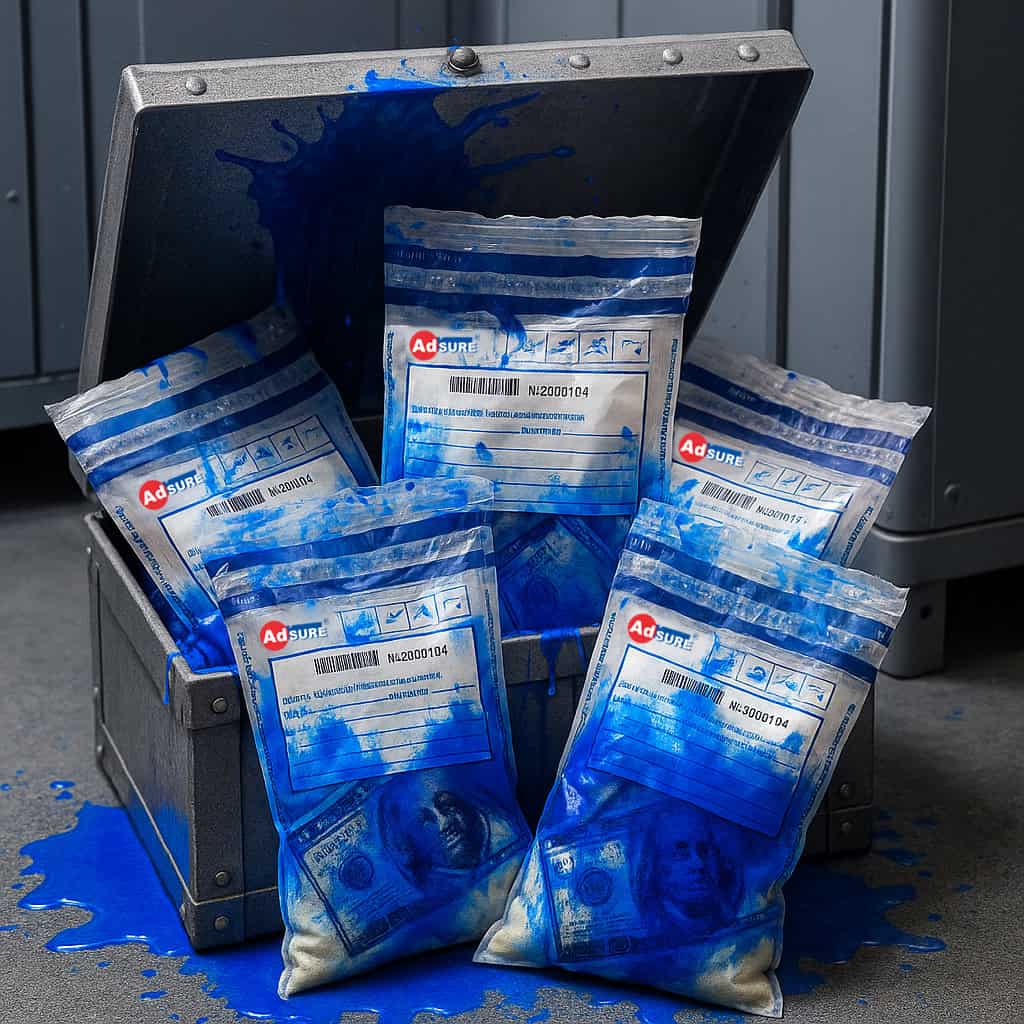
Additionally, banks should use secure packaging for storing and transporting dye packs. Tamper-evident currency bags (such as Adsure’s permeable security bags) are recommended to safely house dye packs and cash bundles during transit or storage. These specialized bags are made of materials that allow the dye to quickly permeate and stain contents if a dye pack activates, while providing tamper-evident seals to deter or detect any interference. Adsure, which began producing security bags in 1985, is one of the earliest and most trusted manufacturers in Asia. Incorporating such secure packaging into the dye pack program adds an extra layer of safety and control over the devices when they’re not in use.
-
Availability to Others: Aside from banks, other cash-handling businesses (retail stores, casinos, armored car services) might consider dye packs or similar cash-neutralizing systems. They would go through the same authorized channels. For private individuals, functional dye packs are not sold commercially. However, on rare occasions disarmed or decommissioned dye packs show up as collector’s items or novelty pieces. For example, a completely disarmed bank dye pack (with the explosive and dye removed) might be sold as a curiosity – such items are legal to own because they have been rendered inert. These typically consist of real but canceled banknotes encasing an empty device shell as a display. Under no circumstances should anyone attempt to create their own explosive dye device; not only is it dangerous, but unauthorized use could result in criminal charges. In summary, exploding dye packs are obtained through secure, vetted channels. Banks looking to implement them should engage established security system providers, and the procurement process will include ensuring compliance with all laws (often working with local police or regulators) and training employees. Dye packs are a proven tool, but they must be handled responsibly and legally within the framework of professional security operations.
In cash-in-transit operations, dye pack technology is often integrated into armored transport cases or secure cash bags. A prime example is the use of ink-permeable security bags designed for CIT, like those made by Adsure. These tamper-evident bags house cash along with an ink or dye release device; if a courier bag is opened without authorization, the bag’s special lining rapidly channels dye through the contents, making the banknotes unusable to thieves. Such solutions extend the dye pack concept beyond the bank branch, protecting cash during transit using the same principle of ruining stolen money.
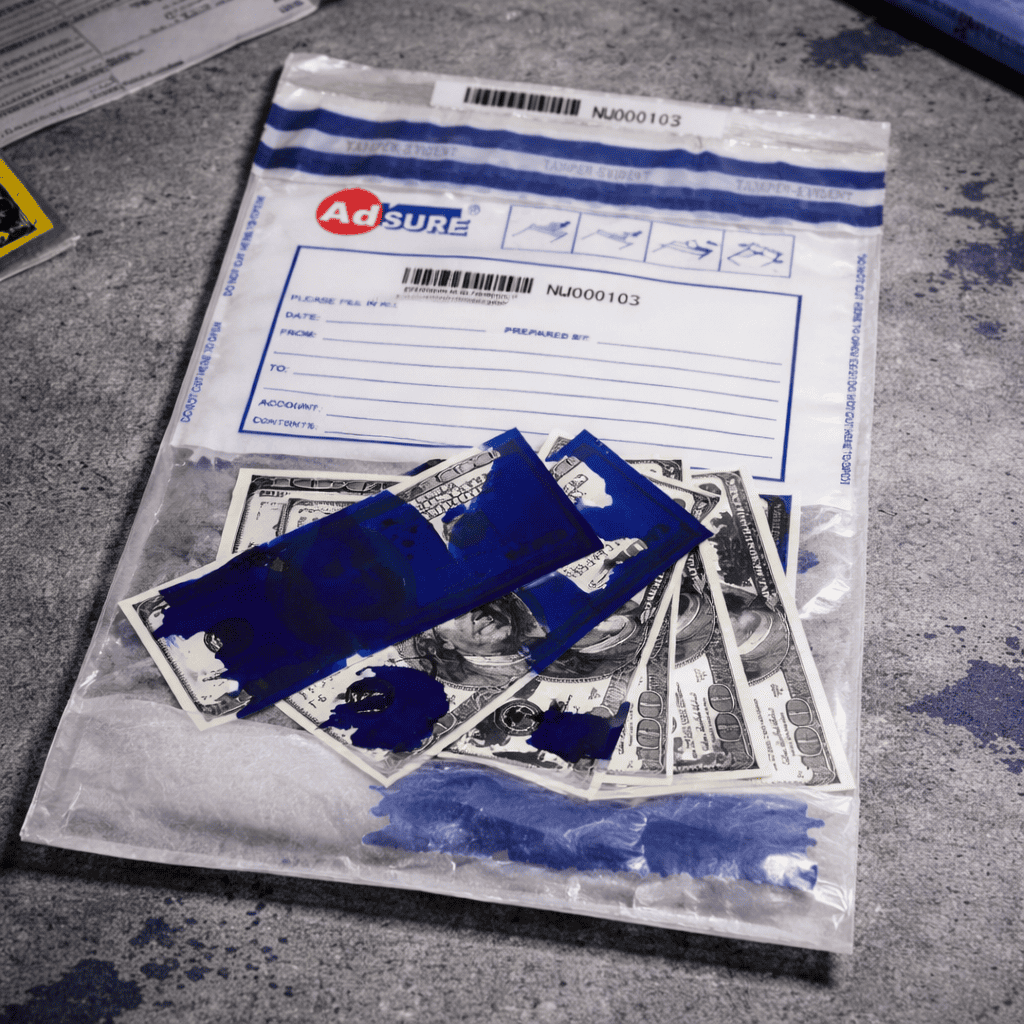
Bank Dye Pack in Action
When a bank employs dye packs, it becomes a silent guardian against robbery. Let’s explore how dye packs are used in banks and how effective they are in real incidents:
-
Concealment and Deployment: In a bank’s cash drawers, dye pack bundles are usually kept alongside real currency, often in teller “bait money” stacks. Only the bank staff can tell which stack contains the dye pack (there may be a subtle marking or a known position familiar to employees). During a robbery, tellers are trained to remain calm and comply with the robber’s demands for cash. While doing so, the teller discreetly includes the special bundle with the dye pack into the money bag. Because modern dye packs are flexible and nearly identical to real stacks of bills, the thief has no easy way to distinguish them in the heat of the moment. The teller will hand over the bag and allow the robber to leave – dye packs are intended to activate once the robber is in flight, ensuring staff and customers inside the bank are safe from the effects.
-
Remote Activation: As described earlier, the moment the robber rushes out the door, the dye pack’s sensor picks up the activation signal and arms the device. Banks coordinate this with their alarm systems – the silent alarm trigger that alerts police can simultaneously ensure the doorway transmitter is on. This means the robber leaves the bank thinking they’ve gotten away, unaware that a countdown to an eruption has begun in their loot bag.
-
Effectiveness and Outcomes: Exploding dye packs have a strong track record of foiling robberies. In many cases, the stained money is recovered immediately because the thief, startled by the explosion or overwhelmed by red smoke, abandons the cash. In the United States, dye packs are credited as one of the reasons the success rate of bank robberies (in terms of robbers escaping with usable cash) has dropped. A significant majority of bank robbers are caught or the money recovered, and dye packs contribute to that outcome. According to industry data, banks utilizing SecurityPac dye packs have collectively recovered tens of millions of dollars that would have been lost, and aided in thousands of arrests.
To illustrate how dye packs work in practice, here are a few real-world incidents where they made all the difference:
-
Marked and Caught in the Act (Pennsylvania, 2010): Two armed men robbed a TD Bank in Plymouth Township one morning, forcing tellers to fill an Adidas backpack with cash. Unbeknownst to them, a dye pack was slipped in. As the robbers fled the bank, witnesses saw a cloud of red smoke billowing as the dye pack detonated on the street. The suspects dropped the cash and even tried to shed their dyed clothing. Police later recovered all the money and noted that the thieves would be literally marked – with red dye on their hands, bodies, and even in their hair. Sure enough, the vivid stains and surveillance footage led investigators to identify and apprehend the perpetrators. The dye pack not only spoiled the robbery but provided evidence on the suspects themselves.
-
Caught Red-Handed (Florida, 2008): In another case, a bank robber in Fort Lauderdale made off with a bag of money from a bank, only to wander into a pawn shop as his next stop. Moments later, the dye pack hidden in his loot exploded inside his pants, sending up red smoke. Startled and now in pain (the device can cause minor burns), the man ditched the money on the pawn shop floor and fled empty-handed. The explosion also released a mace-like chemical that made bystanders’ eyes sting and even triggered a hazmat response. While the suspect initially escaped, the vivid dye stains (and likely some burns) made him an easy target for law enforcement. This incident got plenty of media attention, with headlines about a robber literally “painted” red by his own stolen cash. It stands as a memorable example of the dye pack doing exactly what it’s meant to do – render the cash useless and create a spectacle that leads to arrest.
-
Robber’s “Hot” Cash (Various): There have been many instances of robbers discovering the dye pack only after it’s too late. In some reports, dye packs have exploded inside getaway cars, billowing red smoke out of the vehicle, which practically acts like a flare for police to home in on. In other cases, a thief stuffing the money into their clothing ended up with a dye pack exploding in a pocket (or waistband), resulting in painful burns in rather uncomfortable places and ruined clothes. On a few occasions, panicked robbers have even tried to sue or complain after being foiled by a dye pack, claiming they were injured – a futile gesture given that they were injured in the course of committing a crime. Banks are generally protected from liability as long as the dye pack use conforms to law enforcement guidelines (the devices are designed to be non-lethal and to minimize risk to bystanders). Nonetheless, out of caution, some banks will refrain from using dye packs if a robbery involves hostages or unusual danger, but in the vast majority of cases these packs help resolve the incident swiftly once the robber leaves.
-
Limitations and Considerations: While dye packs are highly effective, bank security managers should be mindful of a few factors. First, dye packs do destroy currency (by design, they deface it); however, since stained notes are marked as stolen, they are typically removed from circulation. (In some countries, central banks will exchange neutralized banknotes for legitimate owners under strict procedures, but criminals cannot simply wash or swap them without exposing themselves.) Banks absorb the loss of any cash that’s burned or glued by their security devices, but that loss is usually trivial compared to what would happen if a robber got away with clean cash. Second, there is a cost and upkeep factor – each dye pack is single-use and must be replaced after it’s triggered, and the radio transmitters and sensors need periodic testing. Some banks have also balanced dye packs with GPS tracking devices hidden in cash (tracking devices can quietly lead police to the suspect, even if the money isn’t marked). In fact, many modern bank security strategies use both: a dye pack to immediately impair the thief’s progress, and a GPS tracker to follow their escape route in real time. The integration of these technologies, along with traditional silent alarms and surveillance cameras, gives security professionals a robust toolkit. Finally, staff cooperation is key. A dye pack is only effective if the teller can include it without tipping off the robber. Training scenarios and drills help prepare employees to execute this under stress. Fortunately, most robbers, in the adrenaline rush of the moment, won’t inspect each bundle of cash. The element of surprise is firmly on the bank’s side.
Conclusion and Key Takeaways
Exploding dye packs have proven themselves as a valuable asset in bank security. They exemplify a clever, low-risk defense: stopping criminals not with force, but with chemistry and cunning. For security professionals considering or managing dye pack systems, here are some key takeaways:
-
Proven Deterrent and Recovery Tool: Dye packs have decades of successful use, foiling countless robberies. They permanently mark stolen cash and suspects, often leading to recovery of money and quick apprehension of criminals. Their very presence in a majority of banks acts as a deterrent – would-be robbers know there’s a good chance any stolen cash will self-destruct shortly after the crime.
-
Safety and Non-Lethality: These devices are designed to be non-lethal. They use dye and irritant gas rather than shrapnel or high explosives. While a dye pack can cause minor burns or irritation, the risk to bank staff and customers is minimal when used correctly (the pack is timed to detonate away from the branch). Still, banks should coordinate with law enforcement and emergency responders, as a dye pack going off may prompt a response (e.g. firefighters or hazmat for the smoke/tear gas, as seen in some cases). Clear protocols should be in place for after a pack explodes – typically, staff will lock the doors and preserve any stained money as evidence until police arrive.
-
Training and Procedure are Vital: A dye pack system is only as good as the people using it. Employee training must cover when and how to include a dye pack during a robbery, and what to do immediately after (e.g. don’t chase the robber—let the pack do its job, then alert authorities). Because each incident is dynamic, staff should exercise good judgment – for example, if a robber seems to spot the dye pack or if there’s a high risk to life, the priority is safety over deployment. Drills with local police can be helpful so that everyone knows what a dye pack detonation looks like and how to respond.
-
Legal Compliance and Liability: Security managers must ensure that the use of dye packs complies with all applicable regulations. In general, banks are allowed to use them, but it’s wise to stay updated on any local restrictions (for instance, some jurisdictions may limit chemical devices). It’s also important to inform insurance providers about these systems. While incidents of third-party injury are exceedingly rare, having clear policies and signage (some banks quietly display signs that stolen money will be marked) can provide legal cover and further deter crime. As a rule of thumb, do not attempt to use dye packs outside of professional security scenarios – private use can lead to unintended consequences and legal trouble.
-
Integration with Broader Security Measures: Consider dye packs as one layer in a multi-layered security approach. They work best alongside tools like GPS trackers, alarm systems, dye/ink tagging systems in ATMs, tamper-evident cash transport bags, and surveillance cameras. For example, a dye pack might stop a robber in their tracks, but a GPS tracker can ensure police trace their location if they manage to keep the money. Likewise, using a secure currency bag (such as Adsure’s permeable security bag) can help contain stained cash and provide immediate evidence of tampering. High-resolution camera footage will also corroborate the evidence (red-stained clothes on camera are pretty damning). An integrated approach maximizes the chances of safely capturing the suspect and preserving the evidence.
In conclusion, exploding dye packs remain a highly effective, affordable, and intelligent security measure for cash-handling businesses. They exemplify the adage “crime doesn’t pay” – quite literally staining ill-gotten gains and thwarting criminals’ getaways. For security professionals, deploying dye packs can provide peace of mind that even if a robbery occurs, the stolen money will self-neutralize and assist in bringing the perpetrators to justice. By understanding the technology, sourcing it through proper channels, and implementing it with robust training and protocols, banks and other institutions can significantly upgrade their defenses against theft. Pairing dye packs with complementary tools—such as tamper-evident cash bags from reputable providers (e.g. Adsure, Asia’s pioneer in security bag manufacturing)—further strengthens this layered defense strategy. The next time you see news of a bank robber discovered with red dye all over their hands, you’ll know exactly how it happened – and why such outcomes are a win for the good guys.


