Can You Bring Cologne on a Plane?
Yes—you can bring cologne on a plane. But whether it can stay in your carry-on, whether it needs to go in checked baggage, and whether a duty-free purchase can make it through a transfer security checkpoint all depend on three things: bottle size, where you bought it, and whether you will go through security again during your journey. Cologne is treated as a liquid under aviation security rules, so the same restrictions that apply to perfume, lotions, and other liquids apply here. ICAO’s LAGs framework, UK government guidance, EU passenger rules, and TSA guidance all align on that basic principle.
For ordinary carry-on packing, the baseline rule is simple: containers over 100 ml are generally not allowed through security unless they fall under a specific exemption. The UK states that at most airports, liquids in containers larger than 100 ml cannot go through security, and the EU likewise says cabin liquids must be in containers no larger than 100 ml, inside a transparent bag up to 1 litre capacity.
That means a 50 ml or 100 ml bottle of cologne is usually fine in hand luggage if packed correctly. A 125 ml, 150 ml, or 200 ml bottle usually is not fine for standard carry-on screening and is better placed in checked baggage. TSA says liquids over 3.4 oz / 100 ml should be packed in checked baggage unless a narrow exception applies.
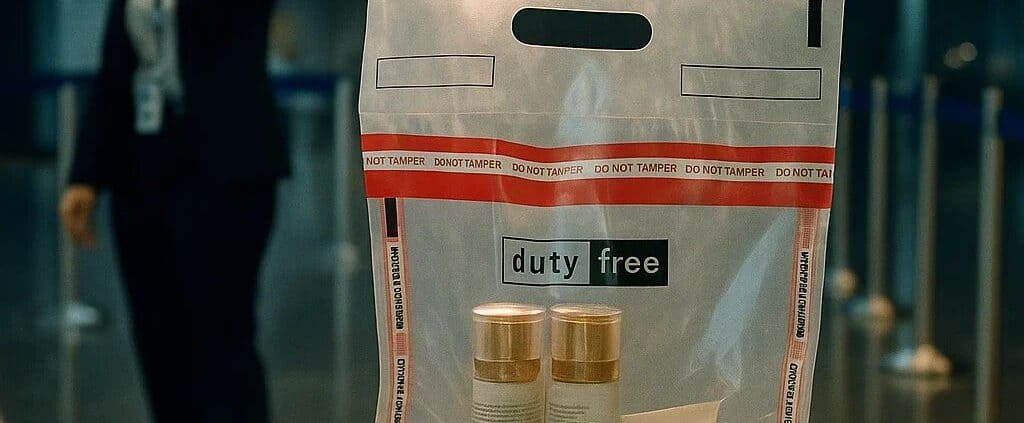
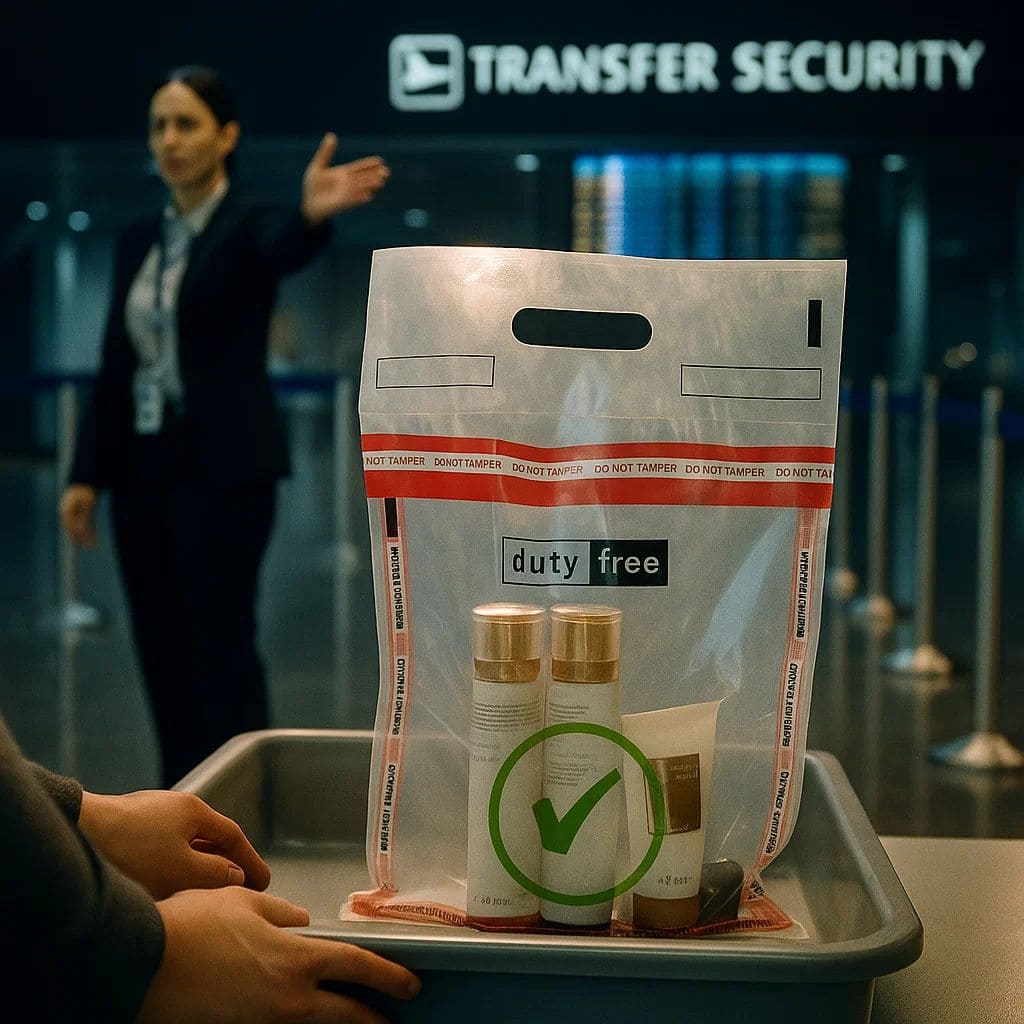
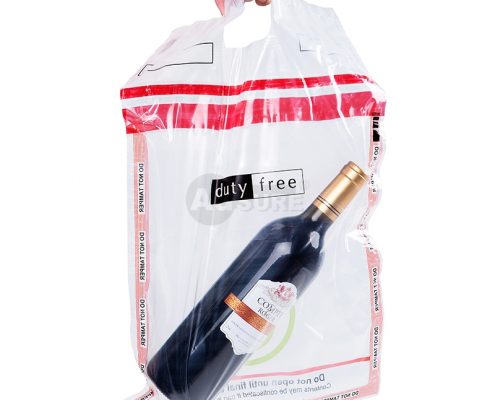
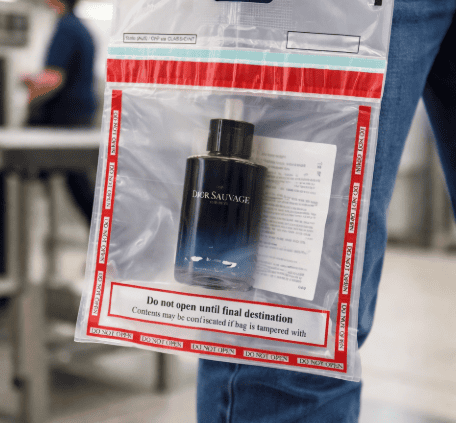
Where travelers get confused is duty-free. A traveler may buy cologne after security at an airport shop, or on board an aircraft, in a bottle larger than 100 ml. In some cases, that item can still continue as cabin baggage during an onward connection—but only if it remains properly sealed in a Security Tamper-Evident Bag, or STEB, with proof of purchase visible. ICAO explains that STEBs were developed to allow an exemption to volumetric controls for liquids purchased at airport retailers or on board aircraft and carried by transfer passengers.
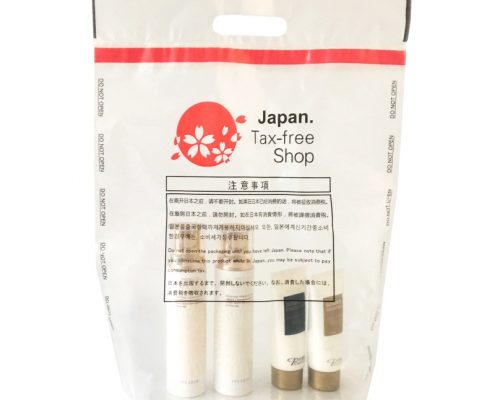
This is the real role of airport duty-free security bags. A STEB is not just a shopping bag. It is a controlled tamper-evident package designed for LAGs—liquids, aerosols, and gels—so security officers can see whether the contents have been opened or interfered with after purchase. ICAO describes STEBs as part of the global response to liquid explosive threats and notes that they are intended for airport and in-flight purchases carried by transfer passengers.
In practice, the scenario looks like this: you buy a 100 ml+ bottle of cologne at the airport duty-free shop after clearing security. The retailer seals the item in a STEB, places the receipt inside, and hands it to you unopened. If your itinerary includes another security checkpoint—for example, an international transfer—security staff may allow that sealed duty-free liquid through because it is still inside the tamper-evident bag with visible proof of purchase. The EU passenger guidance says duty-free liquids may be carried as hand luggage as long as the item and receipt remain sealed inside the security bag provided at purchase, and that if screening staff open the bag, travelers with a connecting flight should ask for the liquids to be resealed in a new security bag.
The UK states the same logic very clearly. Liquids bought at an airport or on a plane can go through security if the items are sealed inside a security bag when purchased and the receipt is sealed inside and visible. It also says the bag must stay closed until the final destination, though airport staff may open it for screening.
British Airways gives a useful real-world version of this transfer scenario: duty-free liquids, gels, or creams over 100 ml can be taken when you have a connecting flight if they were sealed at purchase in a Security Tamper Evident Bag with the receipt inside. BA also notes that if you leave the airport and re-enter security later, staff may need to open and reseal the items in a new bag.
For travelers entering the United States, TSA adds another important condition. TSA says duty-free liquids over 3.4 oz / 100 ml may be carried in a secure, tamper-evident bag only if they were purchased internationally, you are traveling to the U.S. with a connecting flight, the bag shows no signs of tampering, and the original receipt is present with purchase made within 48 hours. TSA also recommends putting liquids over 100 ml into checked baggage even if they are inside a secure tamper-evident bag.
So the short operational answer is this: if your cologne is 100 ml or less, treat it like a normal carry-on liquid. If it is over 100 ml, the safest choice is checked baggage. If it is a duty-free purchase over 100 ml and you still need to pass another checkpoint, keep it sealed in the STEB with the receipt visible and do not open it yourself. Even then, final screening authority remains with airport security.
There is also an important difference between a direct flight and a transfer. On a nonstop itinerary, a duty-free bottle bought after security is often straightforward because you are not presenting it at another checkpoint before boarding your final flight. On a transfer itinerary, especially an international one, the STEB becomes far more important because it serves as the chain-of-custody package for the liquid purchase. That is exactly the kind of real airport use case STEBs were created for.
Another point many travelers overlook is that security rules and customs rules are not the same thing. Security rules determine whether the cologne can pass the checkpoint. Customs rules determine whether you need to declare it when entering a country. The EU and UK both separately describe traveler allowances for “other goods,” which can include perfume. So even if a bottle clears security, it may still count toward customs allowances at destination.
For airport retailers, duty-free operators, and airlines, this is why compliant STEBs matter. The bag is part of the passenger journey, not just part of the packaging. It helps preserve the security status of the product between point of sale and transfer screening, especially for high-value liquid goods such as fragrances, spirits, and cosmetics. ICAO’s own guidance and manufacturer listing reflect how formalized this category has become in aviation security.
In that context, it is worth mentioning Adsure briefly. Adsure’s STEB line is positioned specifically for airport duty-free LAG applications, and Adsure Packaging Limited appears in ICAO’s published list of STEB manufacturers and distributors. That matters because buyers in this category usually care less about generic bag supply and more about whether a manufacturer is aligned with the actual duty-free aviation use case.
Final takeaway
If you are asking, “Can you bring cologne on a plane?” the practical answer is yes—but pack it according to the journey, not just the product.
If the bottle is 100 ml or less, it can usually go in your carry-on under normal liquid rules. If it is larger than 100 ml, checked baggage is usually the safest route. If you buy larger cologne bottles in duty free and still have a transfer ahead, keep them sealed in a proper STEB with the receipt visible and unopened until the trip is over. That is the specific airport scenario where STEBs do their real job.