
RFID Security Bags for Logistics: Real-Time Tracking Meets Tamper-Evident Protection
RFID Security Bags for Logistics: Real-Time Tracking Meets Tamper-Evident Protection
RFID security bags help logistics, banking, retail, pharmaceutical, and high-value goods teams combine tamper-evident packaging with fast digital identification. Instead of treating each shipment as a sealed plastic bag that must be checked manually, RFID security bags add an embedded chip so every bag can be read, verified, and tracked across checkpoints. For companies that need tighter chain of custody, faster audits, and fewer blind spots in transit, this technology turns security packaging into a smarter supply-chain control point.
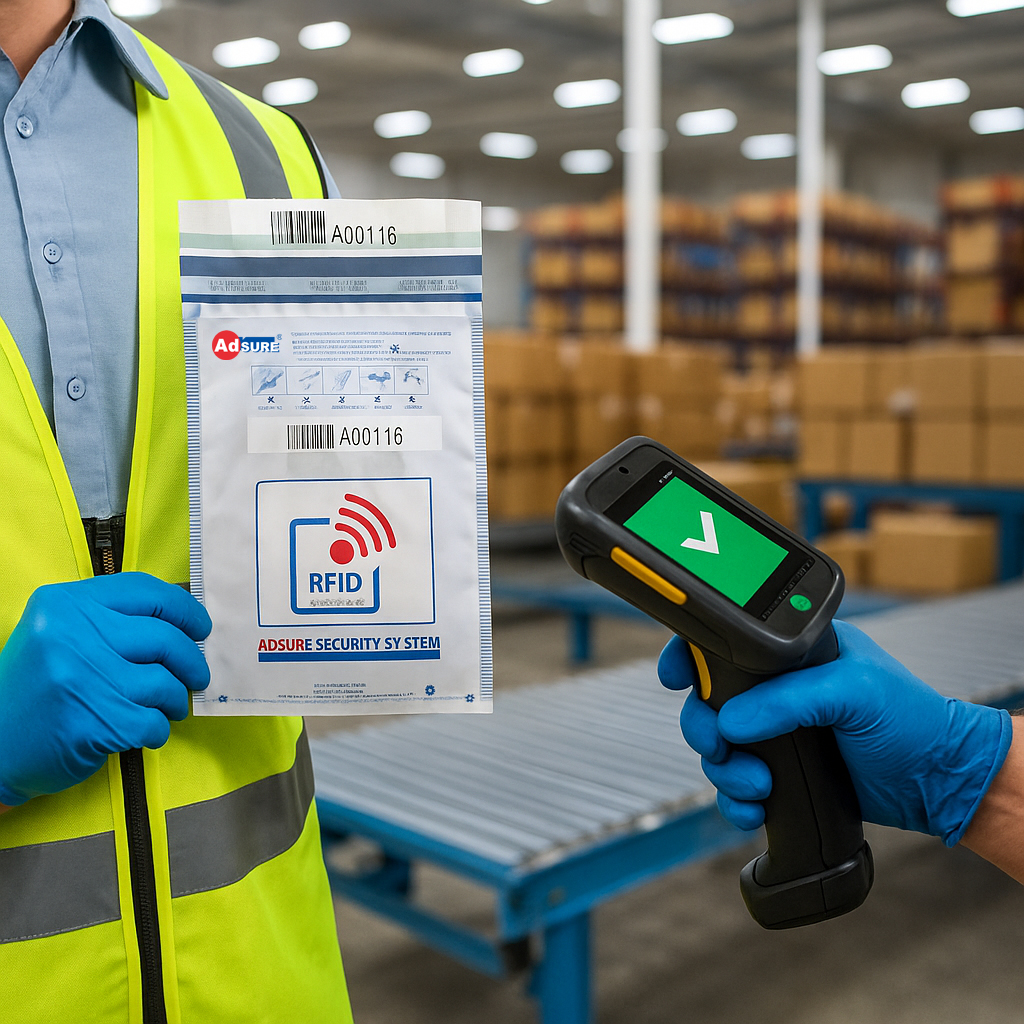
Why RFID Security Bags Are Becoming a Logistics Priority
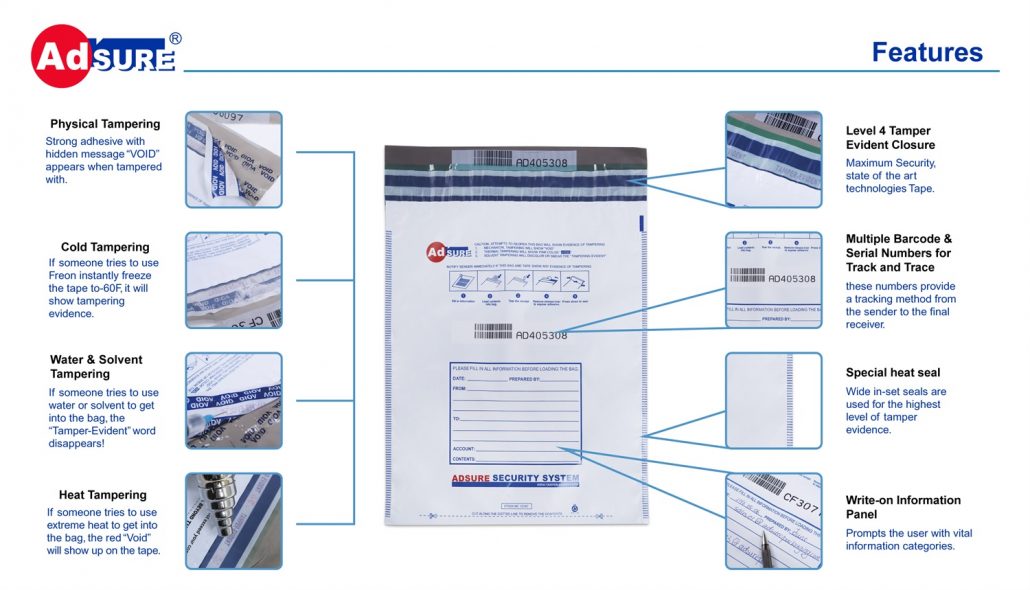
Traditional tamper-evident security bags are effective because they reveal unauthorized opening through security tape, serial numbering, barcodes, void messages, or irreversible seal damage. However, many logistics workflows still depend on manual scanning and visual inspection. That creates friction when a warehouse, bank branch, cash-in-transit operator, or distribution center must verify hundreds or thousands of secure bags per day.
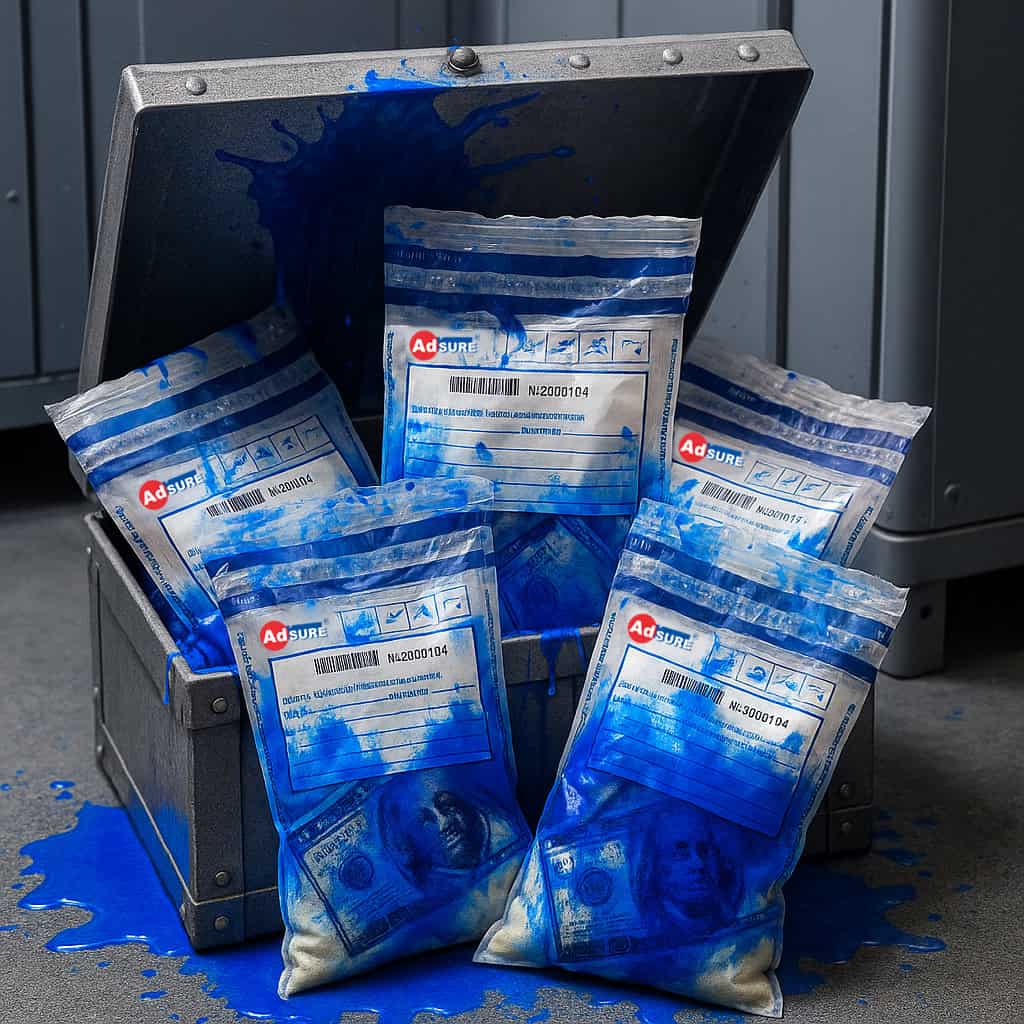
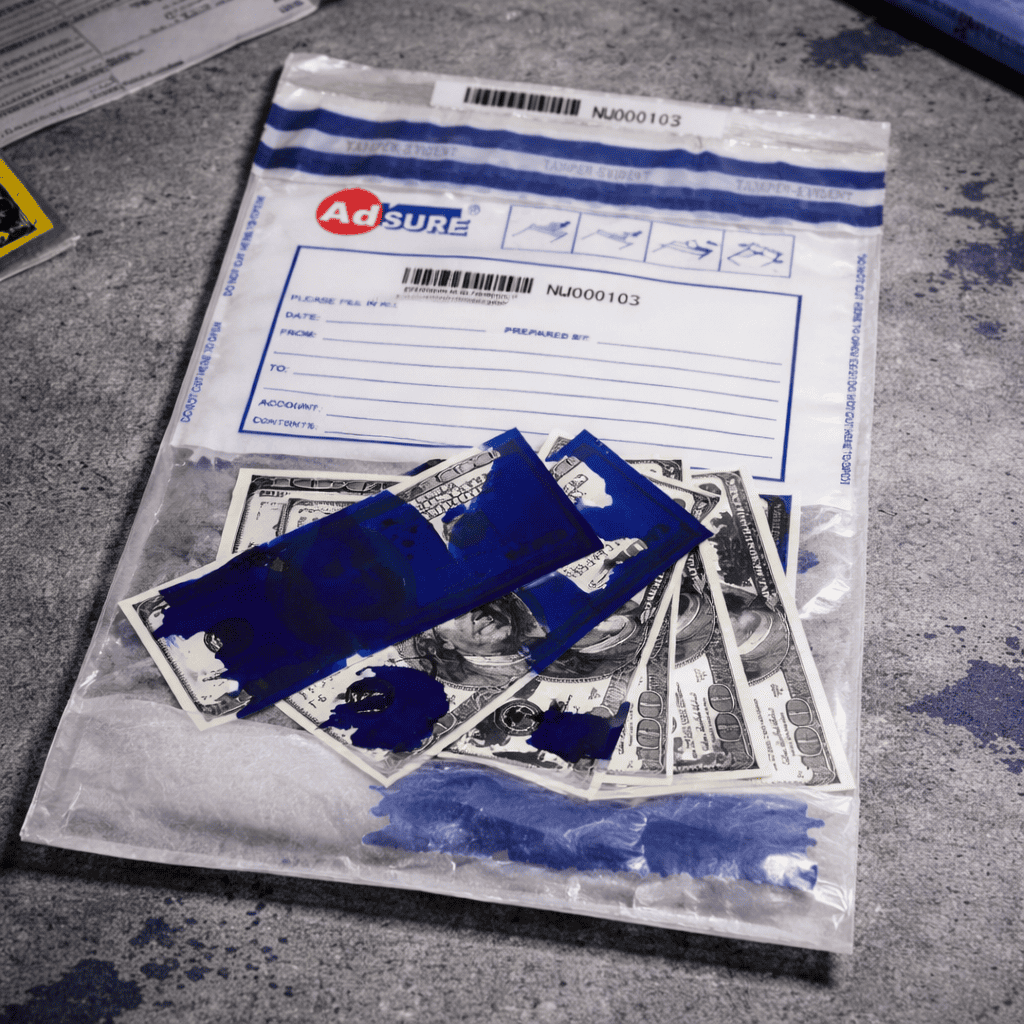
RFID security bags solve this gap by combining physical tamper evidence with digital traceability. Adsure’s RFID Security Bags are designed with RFID transmitter chips and the same security features used in Adsure tamper-evident bags, while still allowing customer-specific sizes, printing, numbering, and operational requirements.1
Industry practice also supports the shift. RFID-based tamper detection can reduce direct visual inspection because multiple tags can be read from a distance without line-of-sight, whereas barcode-based checking generally requires each item to be scanned directly.2 In practical terms, RFID security bags allow a logistics team to confirm bag identity, status, and movement faster, with fewer manual handling steps.
| Logistics challenge | Standard security bag response | RFID security bags response |
|---|---|---|
| Manual checkpoint verification | Visual check plus barcode or serial-number scan | RFID read at receiving, dispatch, vehicle loading, or secure room entry |
| Chain-of-custody records | Paper logs or manual system updates | Digital bag ID tied to scan history and operator workflow |
| High-volume audits | Slow, item-by-item inspection | Batch reading where reader environment supports it |
| Loss prevention | Evidence after seal tampering is found | Earlier exception visibility when a bag fails expected scan status |
| WMS/ERP integration | Often requires manual entry | RFID event data can be mapped into warehouse or logistics systems |
How RFID Security Bags Work in a Chain-of-Custody Workflow
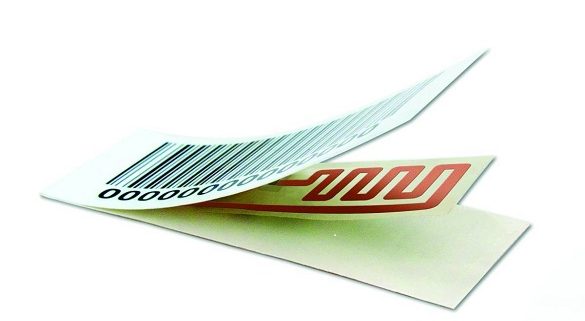
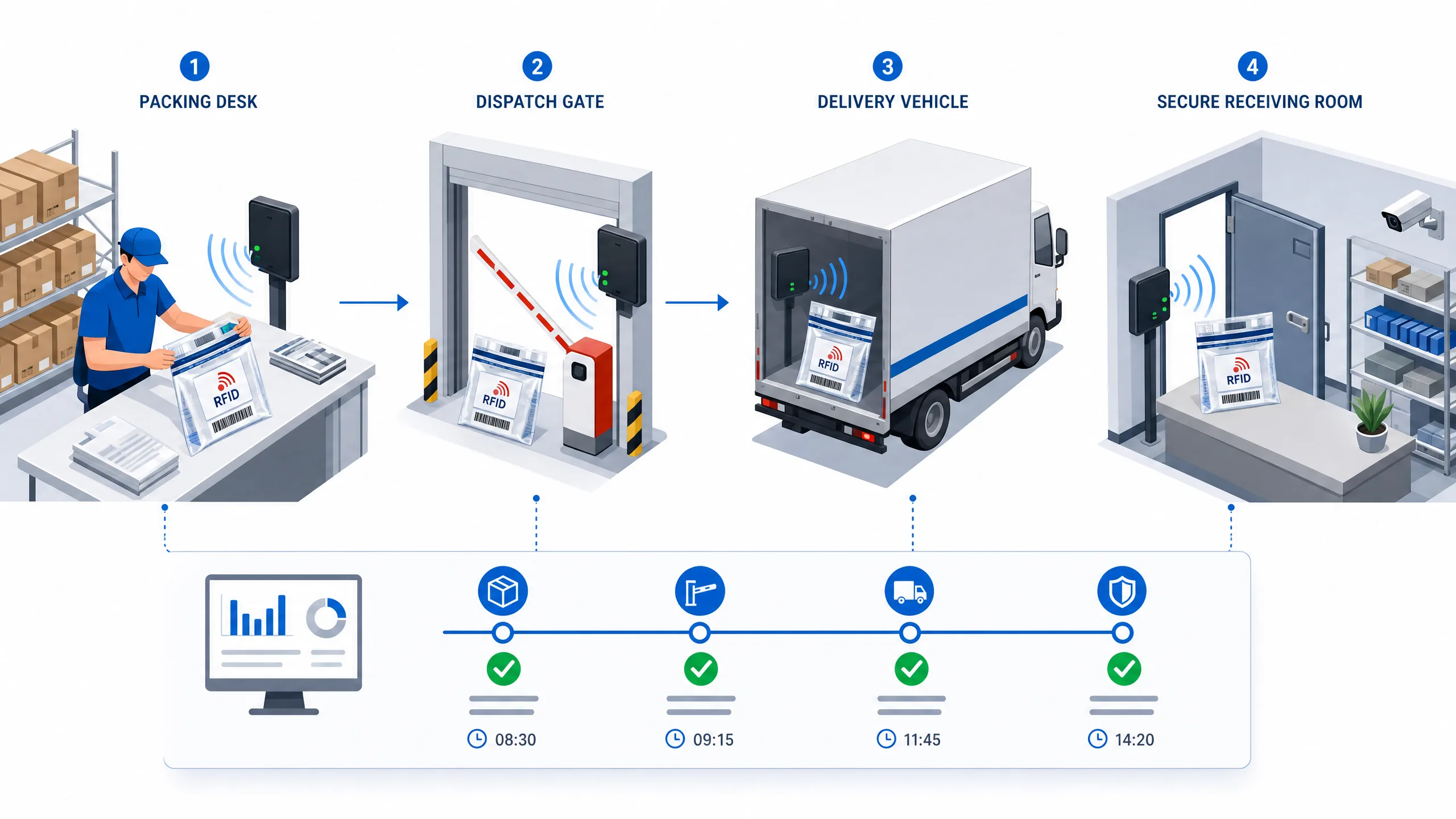
An RFID security bag contains an RFID tag or chip that stores a unique identifier and, depending on the chosen system, may also support shipment references, handling instructions, or other data fields. At each logistics checkpoint, an RFID reader captures the bag’s identity and sends the event to a central system. The organization can then match the physical bag to its expected route, handler, location, and status.
For teams standardizing bag-level identity data, the GS1 RFID standards explain how Electronic Product Codes (EPCs) can be encoded onto RFID tags to support unique identification and supply-chain visibility.
This is the key operational difference between a normal tamper-evident bag and RFID security bags. A standard bag tells you whether a seal appears intact when someone checks it. RFID security bags help document where the bag was read, when it was read, and whether it fits the expected custody path. For high-value shipments, that added visibility can be the difference between a late investigation and an earlier exception alert.
Passive vs. Active RFID Security Bags
Most buyers ask whether they need passive or active RFID security bags. Passive RFID tags are powered by the reader signal, so they are typically more cost-efficient and suitable for checkpoint, warehouse, counter, or secure-room workflows. Active RFID tags include their own power source, so they can support longer read ranges and wider-area asset tracking, but they also raise cost and system complexity.
For many security-bag applications, passive RFID is a strong starting point because the bag only needs to be read at controlled points such as packing, dispatch, vehicle loading, delivery confirmation, evidence transfer, or cash-room intake. Active RFID may be appropriate when the organization needs wider-zone monitoring, yard visibility, or longer-distance automated reads.
| RFID option | Typical fit | Main advantage | Selection note |
|---|---|---|---|
| Passive RFID | Banking deposits, retail cash bags, document custody, pharmaceutical samples, warehouse checkpoints | Lower unit cost and simple checkpoint deployment | Best when readers are installed at defined process points |
| Active RFID | Large facilities, yards, high-value asset movements, long-distance monitoring | Longer read range and continuous visibility potential | Best when the tracking value justifies higher system cost |
Key Benefits of RFID Security Bags for High-Value Goods
The first benefit is faster verification. RFID readers can identify tags without the same line-of-sight requirement that limits barcode processes, and some RFID workflows can read multiple tags in the same pass. For busy cash centers, 3PL hubs, pharmaceutical warehouses, and secure archives, this reduces queue time and creates a cleaner audit trail.
The second benefit is better chain-of-custody control. Each RFID security bag can be connected with a unique serial number, order record, route, shipment ID, or receiving event. If a bag is missing, delayed, or scanned in the wrong location, the system can flag an exception earlier than a purely manual process.
The third benefit is loss prevention and accountability. Tamper-evident packaging discourages unauthorized opening, while RFID tracking improves the evidence trail around possession and movement. This is valuable for banking, cash-in-transit, casinos, law enforcement, medical logistics, retail loss prevention, and electronics distribution.
RFID Security Bags: Applications by Industry
RFID security bags are especially useful where products are valuable, sensitive, regulated, or difficult to replace. In banking and cash-in-transit, they help identify deposits, ATM replenishment bags, and cash movements. In retail, they support store-to-bank deposits and high-loss item transfer. In pharmaceuticals and healthcare, they can reinforce custody records for controlled samples, sensitive medications, or trial materials. In legal, forensic, and government workflows, they add traceability to evidence, documents, records, and restricted materials.
| Industry | Typical contents | Why RFID security bags help |
|---|---|---|
| Banking and cash-in-transit | Cash, coins, ATM cassettes, deposit records | Faster intake, serialized identity, stronger custody history |
| Retail and luxury goods | Daily cash deposits, jewelry, electronics, high-value returns | Loss prevention and easier exception investigation |
| Pharmaceuticals and healthcare | Sensitive samples, controlled products, medical records | Traceable custody and reduced manual handling errors |
| Logistics and 3PL | High-value parcels, documents, replacement parts | Better shipment visibility between controlled checkpoints |
| Law enforcement and government | Evidence, restricted documents, seized property | Stronger auditability and clear transfer records |
Custom RFID Security Bags from Adsure
Adsure’s RFID Security Bags are positioned as high-level tamper-evident bags for transporting money and valuables. The official product range can be supplied with RFID transmitter chips, clear or opaque film options, and custom specifications.1 Standard sizes listed by Adsure include 6×9 inch, 8×10 inch, 9×12 inch, 10×13 inch, 12×15 inch, 14×19 inch, 19×24 inch, and 22×24 inch.1
For buyers, customization is not a cosmetic detail; it is part of the security design. Bag dimensions, film opacity, barcode format, RFID inlay placement, serial numbering, security message, adhesive closure, receipt tear-off, writable panels, and printed instructions all affect real-world usability. A well-designed RFID security bags program should match the reader environment, handling process, contents, and risk level.
If your team is comparing options, start with the dedicated Adsure product page for RFID-enabled bags, then review related Custom Tamper Evident Security Bags for closure styles and printed options. For buyers who need different security levels, Adsure also lists stock options such as Level 2 and Level 4 security bags on the RFID product page.1
What to Specify Before Ordering Trackable Security Bags
A clear specification helps avoid mismatched RFID performance. Before requesting a quotation, define the contents, expected bag dimensions, read points, reader type, read distance, desired data fields, WMS or ERP integration needs, and disposal or reuse policy. The RFID tag must be protected from impact, moisture, abrasion, and handling stress during the full logistics cycle.
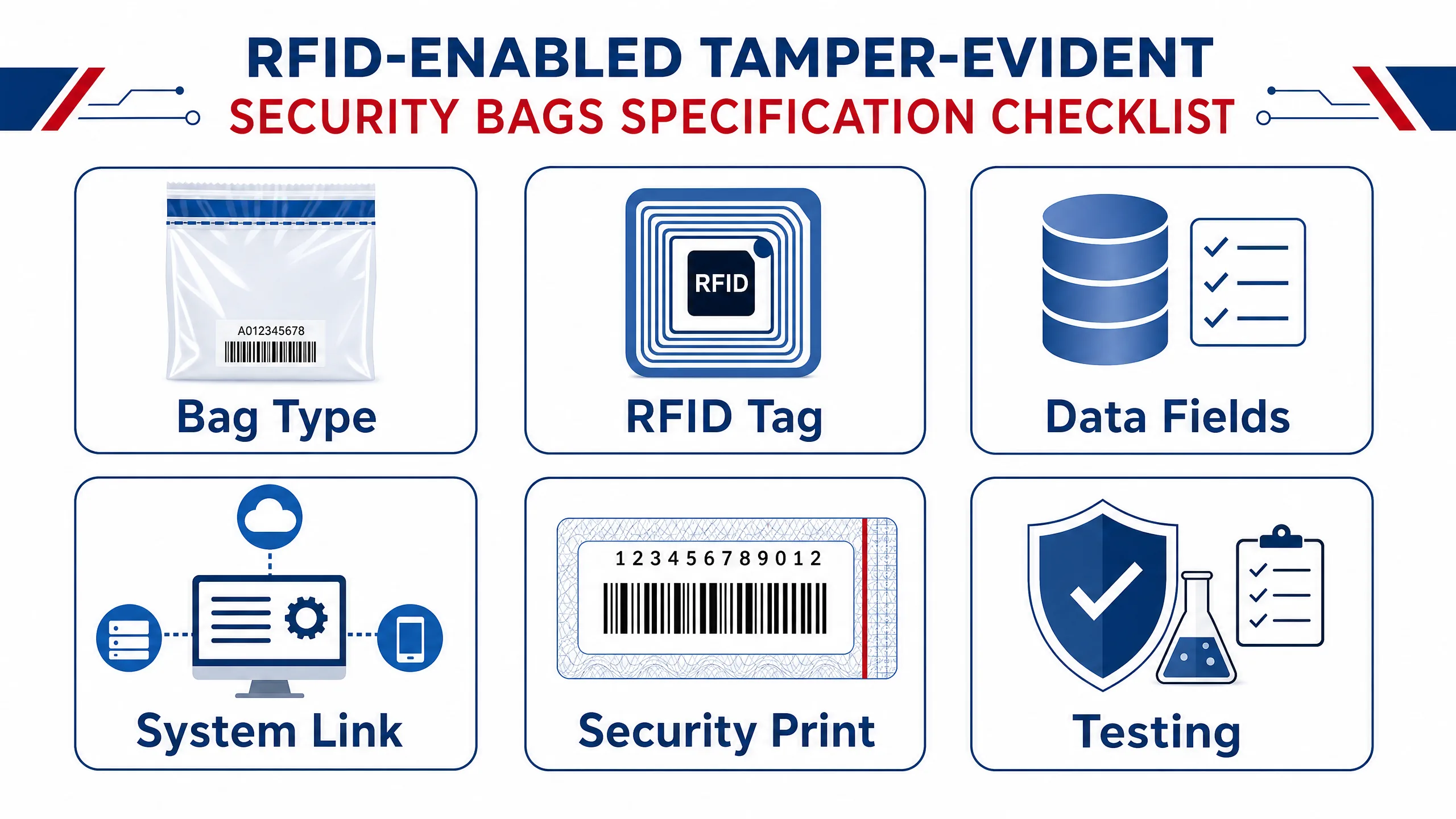
| Specification area | Questions to answer before production |
|---|---|
| Bag construction | Should the bag be clear, opaque, single-use, reusable, heavy-duty, or document-friendly? |
| RFID requirement | Is passive RFID enough, or does the workflow require active RFID and longer read range? |
| Data structure | Should the tag connect to a unique serial number, shipment ID, order number, or custody record? |
| System integration | Will RFID reads be exported into WMS, ERP, TMS, evidence management, or cash-management software? |
| Security print | Do you need barcodes, QR codes, sequential numbering, logos, warning text, or tear-off receipts? |
| Testing | Should samples be validated for readability, seal performance, transit durability, and operator handling? |
Cost and ROI: When Trackable Security Bags Make Commercial Sense
These bags usually cost more than standard tamper-evident bags because they include RFID components and may require reader infrastructure. The business case becomes stronger when the organization has high shipment value, high inspection volume, strict compliance requirements, frequent custody disputes, or meaningful labor cost in manual verification.
A practical ROI model should compare the total process cost, not only the bag price. If the RFID-enabled format reduces manual scanning, shortens receiving time, improves inventory accuracy, prevents losses, or speeds up investigations, the payback can be higher than a simple unit-cost comparison suggests. This is especially true for cash logistics, pharmaceuticals, electronics, luxury retail, and controlled-document operations.
FAQ: Secure RFID Bags
What is an RFID security bag?
An RFID security bag is a tamper-evident bag with an embedded RFID chip or tag. The bag still provides physical tamper evidence, but the RFID component adds a digital identity that can be read at logistics checkpoints. This helps organizations track movement, verify custody, and connect each bag to shipment or inventory records.
How do trackable security bags work for logistics tracking?
RFID-enabled security bags are scanned by RFID readers at defined checkpoints such as packing, dispatch, loading, delivery, or secure-room intake. The reader captures the tag ID and sends the event to a central system. This creates a digital history of where and when the bag was handled without requiring the same line-of-sight process used by barcodes.
Can trackable security bags integrate with a warehouse management system?
Yes, RFID event data can typically be mapped into warehouse management, logistics, cash-management, or evidence-management systems. The exact integration depends on the reader hardware, middleware, tag data structure, and software environment. Adsure can help define the bag specification so it supports the customer’s operational workflow.
Are these bags reusable?
The RFID-enabled format can be designed as single-use or reusable products depending on the material, seal structure, and risk model. Single-use bags are common when irreversible tamper evidence is the priority. Reusable versions may fit closed-loop logistics where the organization can control return, inspection, and cleaning procedures.
What industries benefit most from secure RFID bags?
Banking, cash-in-transit, retail, logistics, pharmaceuticals, healthcare, law enforcement, and government departments benefit most from RFID-enabled bags. These sectors handle valuable or sensitive contents, require reliable custody records, and often need faster verification than manual inspection alone can provide.
Conclusion: Trackable Security Bags Turn Secure Packaging into Supply-Chain Infrastructure
Trackable security bags are a practical upgrade for organizations that need more than a sealed package. They combine tamper-evident protection with digital identity, checkpoint visibility, and stronger chain-of-custody records. For logistics teams managing valuable, sensitive, or regulated contents, these bags can reduce manual work, improve accountability, and create a more reliable security process from packing to final handover.
Get a Free RFID Security Bags Quote Today »
Reviewed by: Adsure Packaging Technical Team
Trademark Disclaimer: Autobag®, SidePouch®, and FAS SPRint Revolution™ are trademarks of Automated Packaging Systems, Inc. (a Sealed Air company). Adsure Packaging is not affiliated with, endorsed by, or authorized by Sealed Air Corporation or Automated Packaging Systems. All compatible products are independently manufactured by Adsure Packaging.