

FFS Machine Film: Custom Rollstock for VFFS and HFFS Lines
Selecting the right FFS machine film is critical for maintaining high-speed production on vertical and horizontal form-fill-seal packaging lines. When the rollstock lacks the proper physical properties, operators often face film tracking issues, wrinkling, or weak seals that disrupt the entire packaging workflow.

At Adsure Packaging, we engineer flexible packaging rollstock designed to match your specific machinery and product requirements. By customizing thickness, friction control, and sealing layers, our films help manufacturers reduce line downtime and optimize their automated packaging operations.
Machine-Specific Applications for VFFS and HFFS
Form-fill-seal packaging is not a single process; it involves different mechanical forces depending on whether the machine operates vertically or horizontally. A precision-engineered film must adapt to the specific contact points and speeds of these platforms.
Vertical Form-Fill-Seal (VFFS) Integration
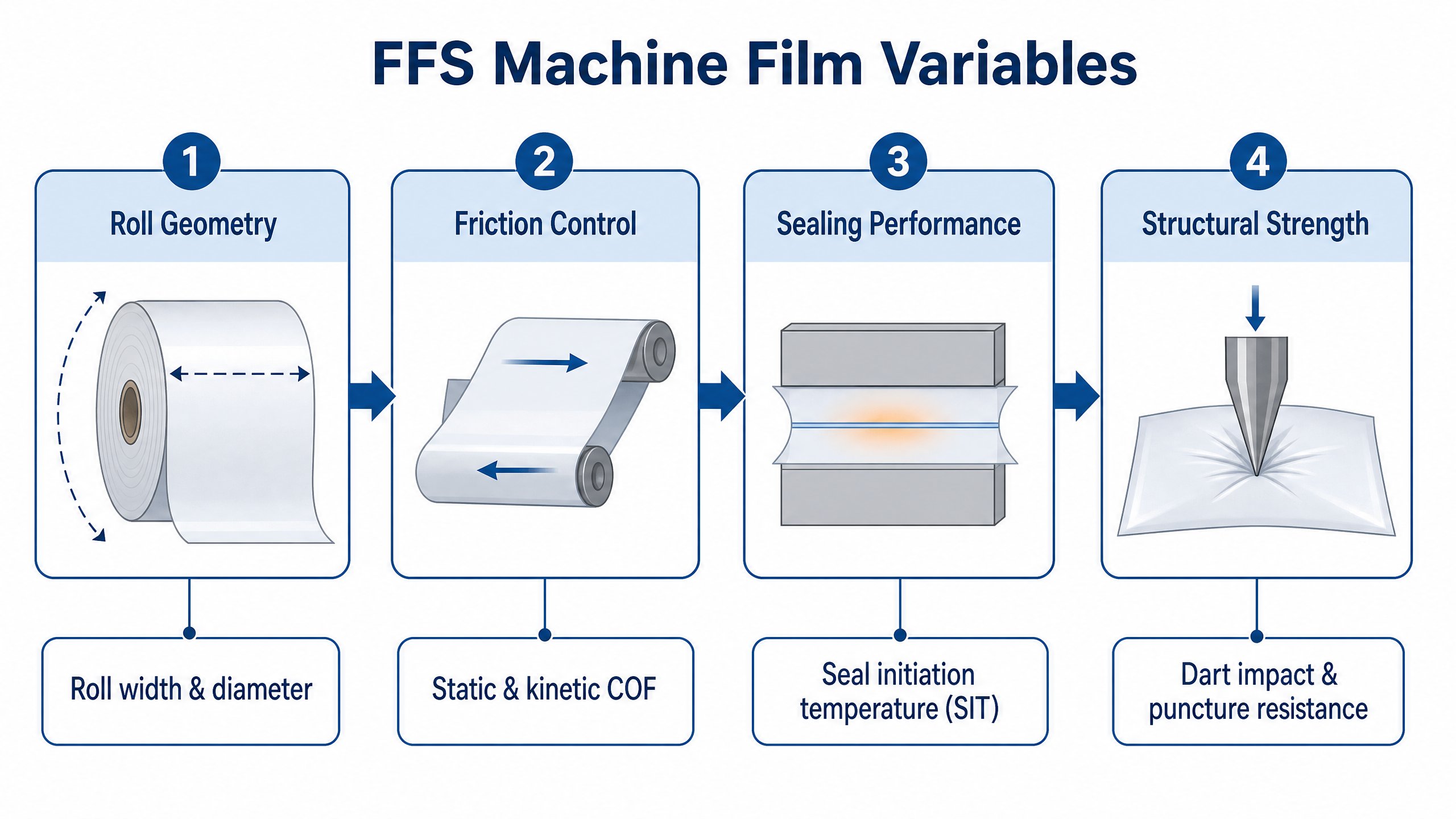
On VFFS lines, gravity drives the filling process, placing immediate stress on the film. As the rollstock travels over the forming collar and down the filling tube, the film’s coefficient of friction (COF) must be low enough to prevent drag and wrinkling, yet stable enough for the drive belts to maintain grip. This balance is especially critical when packaging dense, free-flowing products like chemical fertilizers, resin pellets, or animal feed.
Furthermore, because the product drops directly onto the newly formed bottom seal, the film requires exceptional hot tack strength. Our VFFS-optimized films are formulated to secure the load before the seal fully cools, preventing burst bags during the high-impact filling stage.
Horizontal Form-Fill-Seal (HFFS) Integration
HFFS machines are typically used for solid, individual, or tray-supported items. Here, the film is pulled horizontally through a forming plow and sealing jaws. The primary challenges involve maintaining consistent web tension and achieving a clean, reliable seal without distorting the package shape. Our HFFS films focus on gauge tolerance and stiffness, ensuring the rollstock feeds smoothly and presents a crisp, wrinkle-free appearance on the retail shelf.
Quality Assurance and Third-Party Testing
When transitioning to a new FFS machine film, industrial buyers require more than just a specification sheet; they need documented quality assurance. At Adsure Packaging, our quality management and certification portfolio—which includes ISO, WCA, and GRS—reflects our commitment to manufacturing standards.
For specific material compliance, many packaging engineers rely on third-party laboratory reports. While Adsure maintains SGS testing records as part of our corporate quality documentation, the exact test scope—such as heavy metal limits, migration tests, or material composition—varies by film structure and intended use. We encourage buyers to request and review the specific SGS reports or testing certificates that correspond to their chosen film formulation and target market before moving to full-scale production.
How to Choose the Right FFS Machine Film
When selecting rollstock for your packaging line, you must consider both the machine’s specifications and the product’s physical demands. Start by evaluating the required dart drop impact strength and puncture resistance, especially if you are packaging heavy industrial materials, angular resin pellets, or bulky pet food.
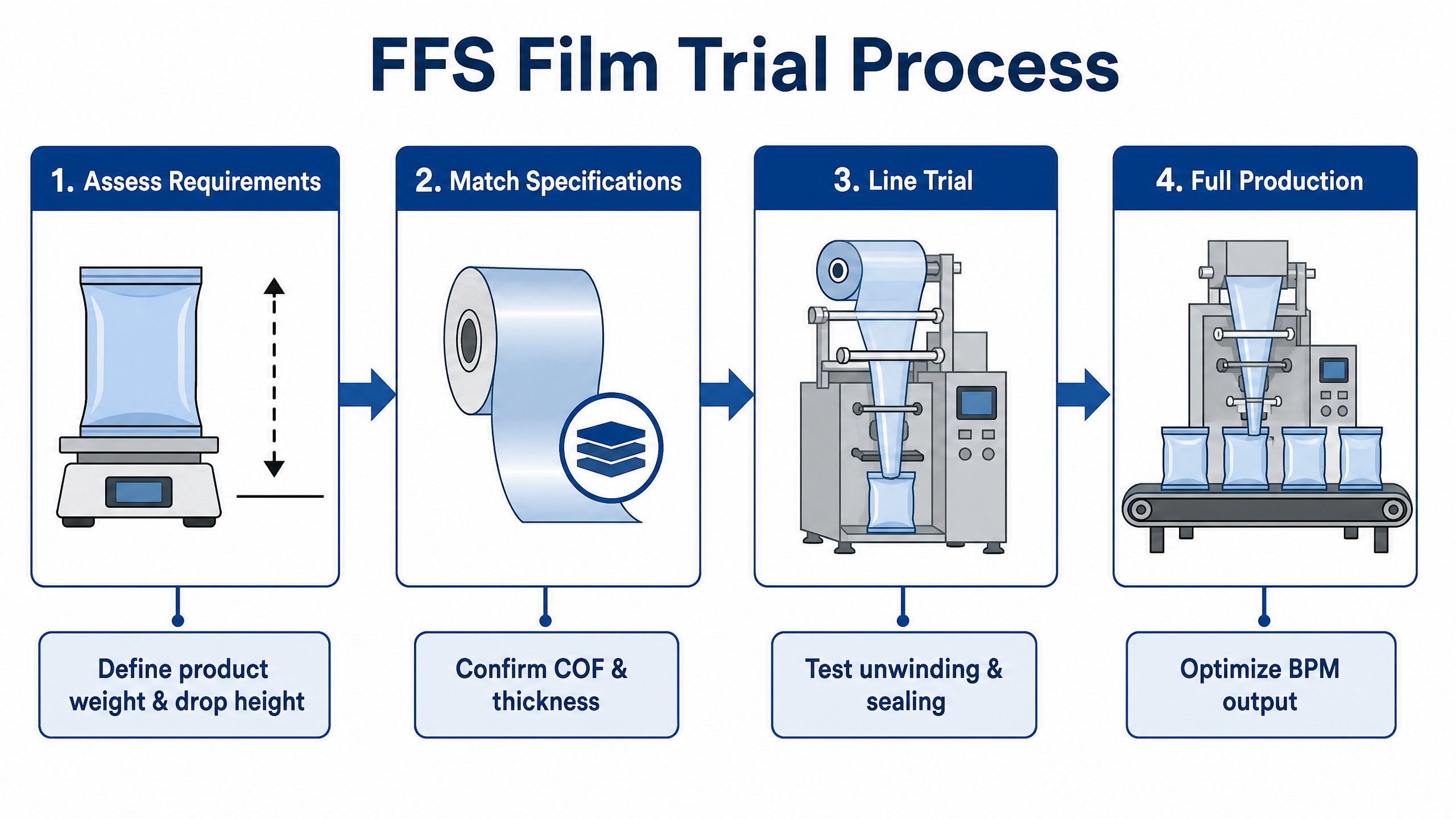
Next, ensure that the film’s gauge tolerance is consistent to maintain stable web tension. We recommend discussing your exact drop height, fill weight, and machine model with your supplier to determine whether a 3-layer or 5-layer co-extrusion structure is most appropriate. For more insights on preventing production bottlenecks, read our guide on how to reduce downtime on FFS packaging lines.
Conclusion: Partnering for FFS Machine Film Efficiency
Investing in the right FFS machine film is a strategic decision that directly impacts your packaging line’s reliability and overall operational efficiency. By partnering with a manufacturer that understands the critical balance of VFFS and HFFS machine dynamics, friction control, and third-party quality verification, you can achieve consistent, high-quality packaging for your products.
Reviewed by: Adsure Packaging Technical Team
Frequently Asked Questions
How does VFFS film differ from HFFS film?
While both are form-fill-seal materials, VFFS film often requires higher hot tack strength and specific COF control to handle gravity-fed product drops and forming collar friction. HFFS film typically prioritizes stiffness and gauge consistency for smooth horizontal feeding and clean presentation.
Can FFS film be customized for heavy-duty applications?
Yes, heavy-duty applications often require 3-layer or 5-layer co-extruded films to achieve the necessary dart impact and puncture resistance. The film thickness and structure are customized based on the product weight, drop height, and specific handling requirements.
What role do SGS reports play in FFS film selection?
SGS reports and similar third-party tests verify specific material properties, such as chemical compliance or structural composition. Because testing scopes vary by formulation, buyers should review the exact SGS documentation applicable to their custom film structure to ensure it meets their regulatory and performance needs.
References
[1] Packaging World. “Film Criteria for Vertical Form/Fill/Seal Applications.”
[2] ASTM International. “ASTM D1894-24 Standard Test Method for Static and Kinetic Coefficients of Friction of Plastic Film and Sheeting.”


