
Posts

FFS machine film running through a vertical form-fill-seal packaging line

FFS Machine Film: Custom Rollstock for VFFS and HFFS Lines

Selecting the right FFS machine film is critical for maintaining high-speed production on vertical and horizontal form-fill-seal packaging lines. When the rollstock lacks the proper physical properties, operators often face film tracking issues, wrinkling, or weak seals that disrupt the entire packaging workflow.
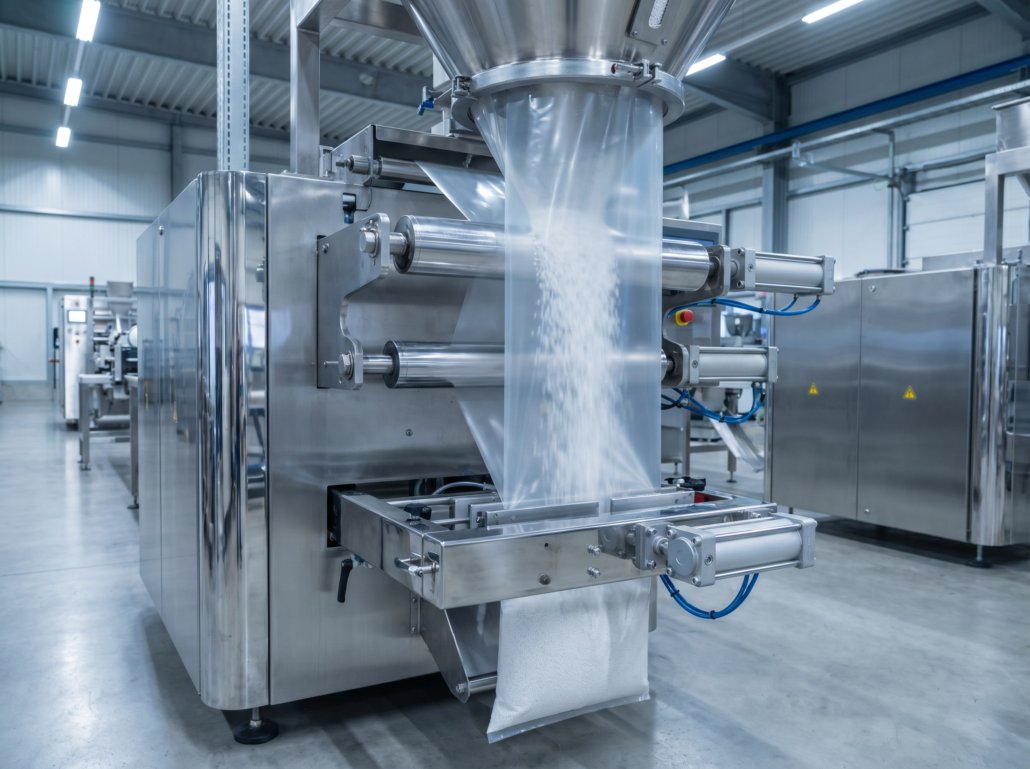
FFS machine film running through a vertical form-fill-seal packaging line

At Adsure Packaging, we engineer flexible packaging rollstock designed to match your specific machinery and product requirements. By customizing thickness, friction control, and sealing layers, our films help manufacturers reduce line downtime and optimize their automated packaging operations.

Machine-Specific Applications for VFFS and HFFS

Form-fill-seal packaging is not a single process; it involves different mechanical forces depending on whether the machine operates vertically or horizontally. A precision-engineered film must adapt to the specific contact points and speeds of these platforms.

Vertical Form-Fill-Seal (VFFS) Integration

On VFFS lines, gravity drives the filling process, placing immediate stress on the film. As the rollstock travels over the forming collar and down the filling tube, the film’s coefficient of friction (COF) must be low enough to prevent drag and wrinkling, yet stable enough for the drive belts to maintain grip. This balance is especially critical when packaging dense, free-flowing products like chemical fertilizers, resin pellets, or animal feed.

Furthermore, because the product drops directly onto the newly formed bottom seal, the film requires exceptional hot tack strength. Our VFFS-optimized films are formulated to secure the load before the seal fully cools, preventing burst bags during the high-impact filling stage.

Horizontal Form-Fill-Seal (HFFS) Integration

HFFS machines are typically used for solid, individual, or tray-supported items. Here, the film is pulled horizontally through a forming plow and sealing jaws. The primary challenges involve maintaining consistent web tension and achieving a clean, reliable seal without distorting the package shape. Our HFFS films focus on gauge tolerance and stiffness, ensuring the rollstock feeds smoothly and presents a crisp, wrinkle-free appearance on the retail shelf.
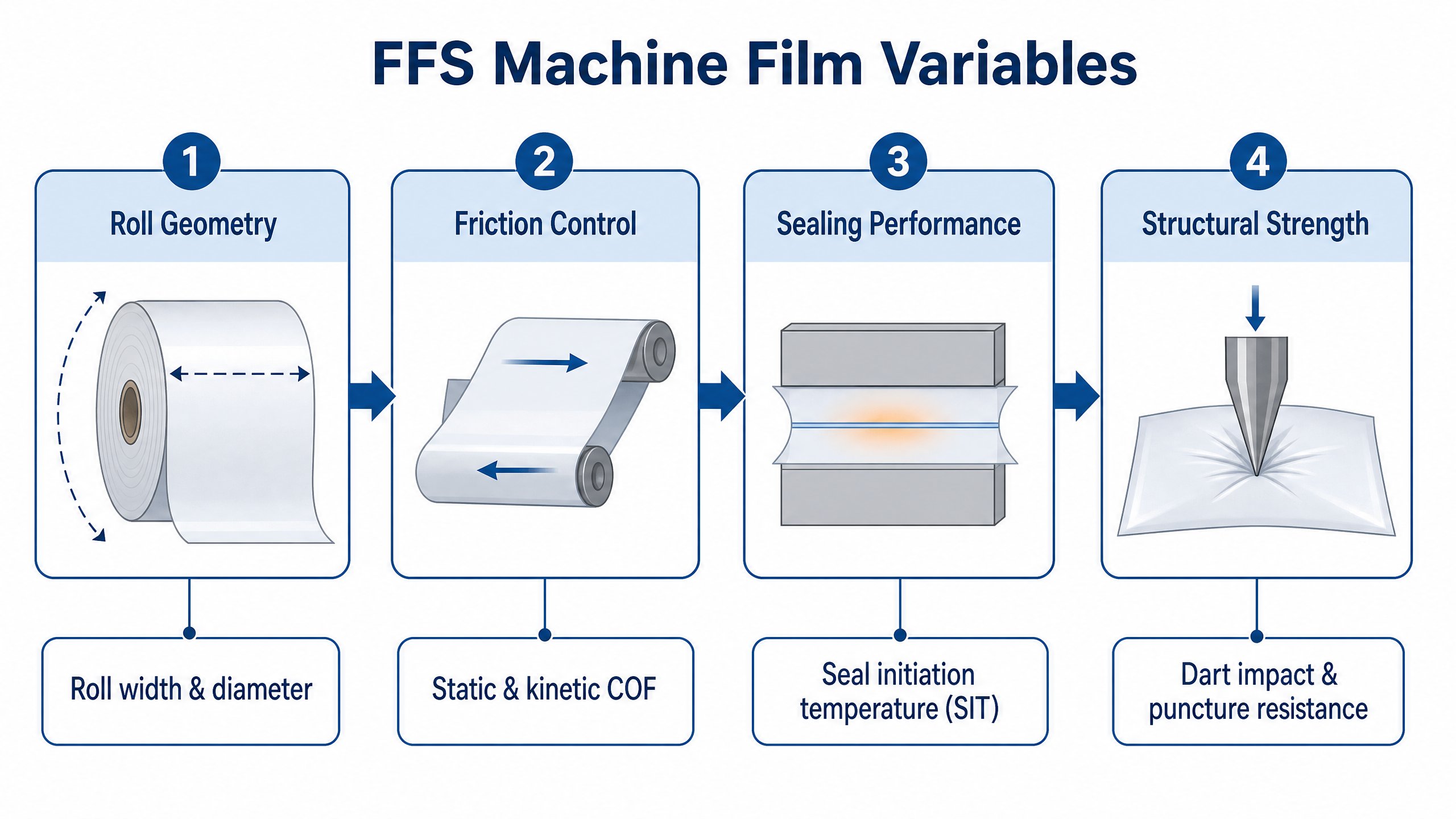
FFS Machine Film Variables showing Roll Geometry, Friction Control, Sealing Performance, and Structural Strength

Quality Assurance and Third-Party Testing

When transitioning to a new FFS machine film, industrial buyers require more than just a specification sheet; they need documented quality assurance. At Adsure Packaging, our quality management and certification portfolio—which includes ISO, WCA, and GRS—reflects our commitment to manufacturing standards.

For specific material compliance, many packaging engineers rely on third-party laboratory reports. While Adsure maintains SGS testing records as part of our corporate quality documentation, the exact test scope—such as heavy metal limits, migration tests, or material composition—varies by film structure and intended use. We encourage buyers to request and review the specific SGS reports or testing certificates that correspond to their chosen film formulation and target market before moving to full-scale production.

How to Choose the Right FFS Machine Film

When selecting rollstock for your packaging line, you must consider both the machine’s specifications and the product’s physical demands. Start by evaluating the required dart drop impact strength and puncture resistance, especially if you are packaging heavy industrial materials, angular resin pellets, or bulky pet food.

Next, ensure that the film’s gauge tolerance is consistent to maintain stable web tension. We recommend discussing your exact drop height, fill weight, and machine model with your supplier to determine whether a 3-layer or 5-layer co-extrusion structure is most appropriate. For more insights on preventing production bottlenecks, read our guide on how to reduce downtime on FFS packaging lines.
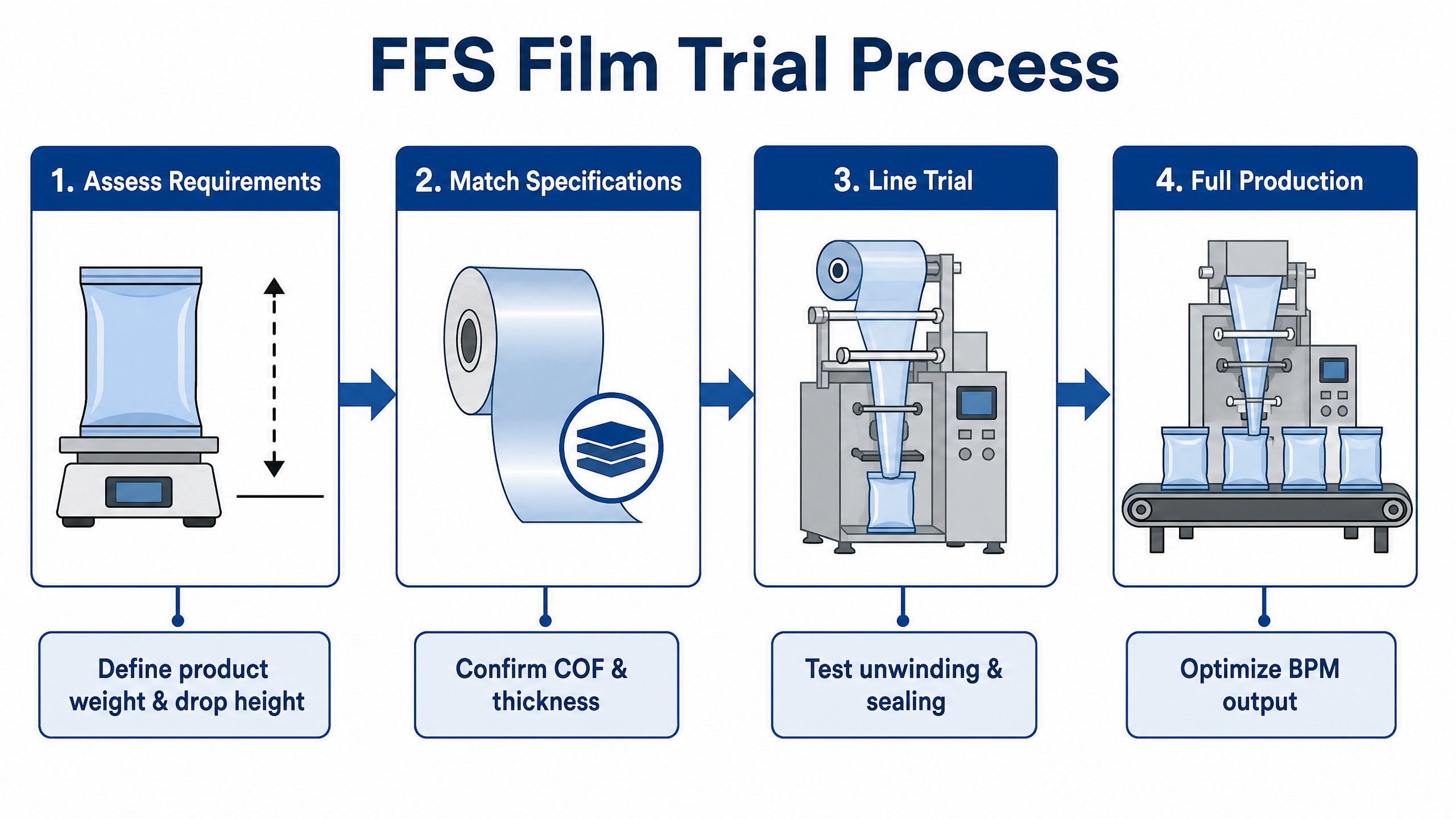
FFS Film Trial Process showing Assess Requirements, Match Specifications, Line Trial, and Full Production

Conclusion: Partnering for FFS Machine Film Efficiency

Investing in the right FFS machine film is a strategic decision that directly impacts your packaging line’s reliability and overall operational efficiency. By partnering with a manufacturer that understands the critical balance of VFFS and HFFS machine dynamics, friction control, and third-party quality verification, you can achieve consistent, high-quality packaging for your products.

Get a Free Quote Today »

Reviewed by: Adsure Packaging Technical Team

Frequently Asked Questions

How does VFFS film differ from HFFS film?

While both are form-fill-seal materials, VFFS film often requires higher hot tack strength and specific COF control to handle gravity-fed product drops and forming collar friction. HFFS film typically prioritizes stiffness and gauge consistency for smooth horizontal feeding and clean presentation.

Can FFS film be customized for heavy-duty applications?

Yes, heavy-duty applications often require 3-layer or 5-layer co-extruded films to achieve the necessary dart impact and puncture resistance. The film thickness and structure are customized based on the product weight, drop height, and specific handling requirements.

What role do SGS reports play in FFS film selection?

SGS reports and similar third-party tests verify specific material properties, such as chemical compliance or structural composition. Because testing scopes vary by formulation, buyers should review the exact SGS documentation applicable to their custom film structure to ensure it meets their regulatory and performance needs.

References

[1] Packaging World. “Film Criteria for Vertical Form/Fill/Seal Applications.”
[2] ASTM International. “ASTM D1894-24 Standard Test Method for Static and Kinetic Coefficients of Friction of Plastic Film and Sheeting.”
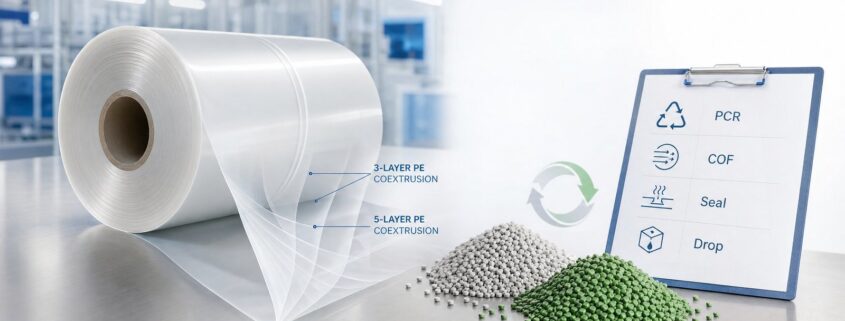
PCR FFS film roll for recyclable mono PE industrial packaging with application testing checklist

How to Choose PCR Content for Mono PE FFS Film: Why Up to 30% Needs Application Testing

PCR FFS film is becoming an important material choice for brands, industrial packers, and packaging engineers preparing for recyclable packaging expectations in Europe. A mono PE structure can support a more recycling-oriented design, while post-consumer recycled content helps reduce reliance on virgin plastic. However, the phrase “up to 30% PCR” should not be treated as a fixed number for every bag, every product, or every form-fill-seal line. In real production, PCR content must be selected through application testing.

PCR FFS film application testing matrix for different bag weights and product risks

Adsure’s EU Recyclable Mono PE FFS Film with up to 30% PCR Content is designed for vertical and horizontal form-fill-seal packaging lines, with customizable COF, film thickness, roll width, sealing layer formulation, printing, and a 3-layer PE co-extrusion structure. The purpose of this article is to explain how buyers should evaluate PCR percentage before ordering, and why sample testing is the safest path for heavy-duty packaging, printed packaging, and European-market projects.

Why PCR FFS Film Is Not a One-Number Specification

A realistic PCR target depends on the filling product, bag weight, drop height, film thickness, pigment, ink coverage, sealing temperature, and machine speed. A 5 kg pet food pack and a 50 kg fertilizer sack may both use mono PE FFS film, but they do not have the same mechanical risk. The lighter pack may focus on appearance, printing, and barcode readability, while the heavier sack may need stronger puncture resistance, higher dart impact, and reinforced sealing performance.

Specification factor Why it affects PCR percentage Practical buyer question
Filling weight Heavier bags place more stress on seals, corners, and palletized loads. Will the bag survive 25 kg or 50 kg filling and handling?
Product shape Sharp granules and powders with hard particles increase puncture risk. Is the product fertilizer, resin, feed, salt, or powder?
Printing coverage Heavy ink coverage can affect recyclability, appearance, and process control. Is the pack plain, white, tinted, matte, or heavily printed?
Machine speed Faster FFS lines need stable unwinding, tracking, and heat-sealing windows. What are the VFFS or HFFS speed and sealing parameters?
PCR source quality PCR consistency influences gels, odor, color variation, and mechanical stability. Has the PCR resin been qualified for this structure?

What “Up to 30% PCR” Means in Mono PE FFS Film

“Up to 30% PCR” means the film can be engineered with post-consumer recycled PE content reaching 30% when the application, thickness, color, printing, and performance requirements allow it. It does not mean every specification should automatically use 30% PCR without validation. This distinction is important for honest sustainability communication and for reducing packaging failure risk.

For many non-food-contact industrial applications, 30% PCR can be a practical target when the recycled material is placed in the core layer and protected by optimized outer and inner layers. Adsure uses a 3-layer PE co-extrusion structure, where the core layer can carry PCR content, the outer layer supports strength and printability, and the inner sealant layer is adjusted for low seal initiation temperature and seal integrity. This three-layer design can be customized for 5 kg to 50 kg applications through thickness, resin selection, COF control, and application testing.

How to Select PCR FFS Film by Application Risk

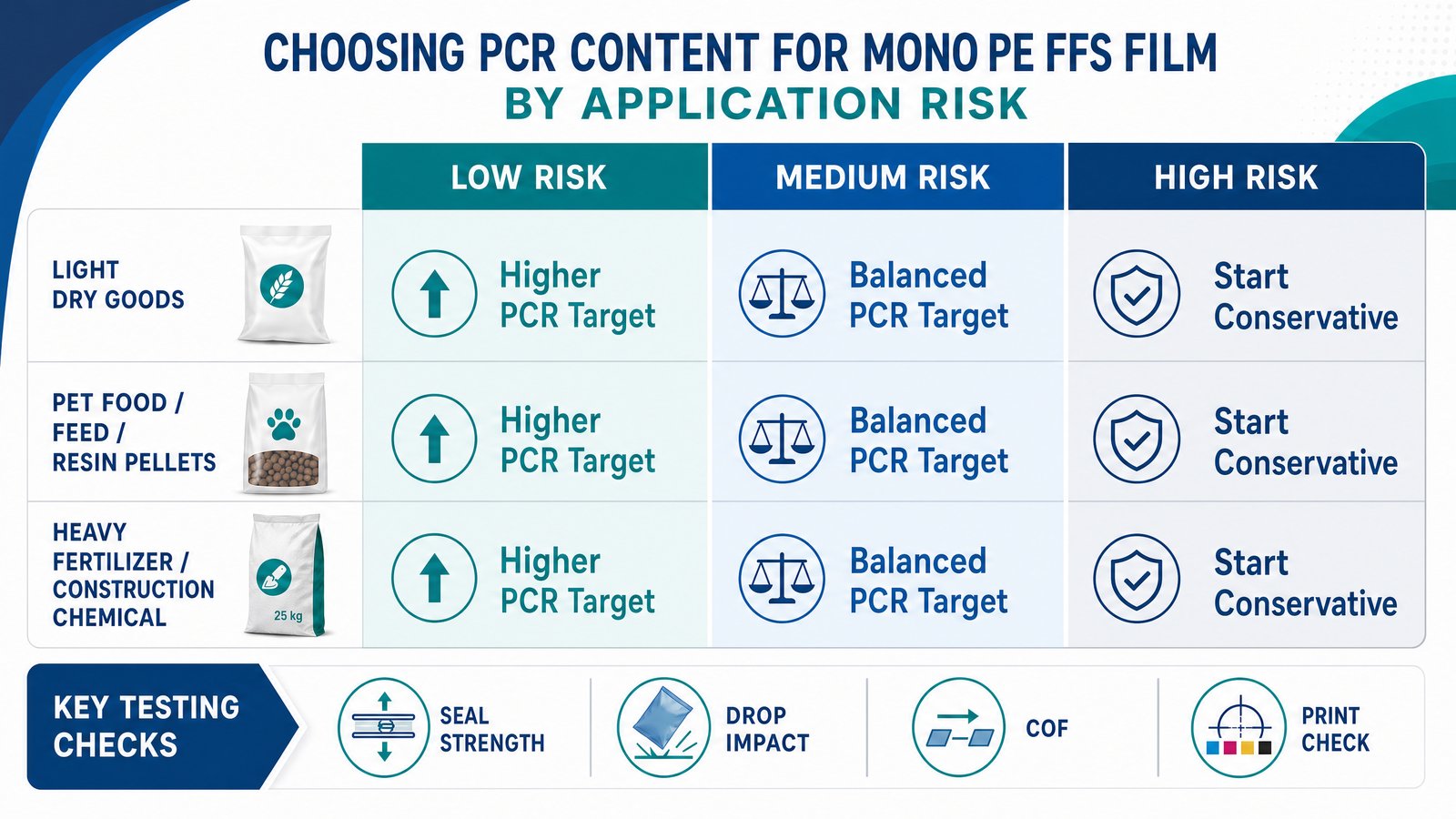
A practical way to choose PCR FFS film is to classify the application by packaging risk. Low-risk applications may be able to start near the upper PCR target earlier, while high-risk applications should begin with a more conservative formulation and then increase PCR content after testing.

Application risk level Typical products Suggested development direction Testing emphasis
Lower risk Light dry goods and small consumer-size packs Evaluate higher PCR targets earlier if appearance requirements allow. Seal appearance, print quality, film tracking, basic drop testing.
Medium risk Pet food, animal feed, rice, flour, salt, resin pellets Balance PCR content with puncture resistance and controlled COF. Dart impact, tear resistance, seal strength, line trial.
Higher risk Fertilizer, construction chemicals, tile adhesive, heavy powders, 25–50 kg sacks Use a reinforced 3-layer PE co-extrusion design and validate before mass production. Drop impact, hot tack, creep resistance, pallet stability, shipping simulation.

Why PCR Content Affects Strength, Sealing, and Appearance

PCR FFS film must satisfy both sustainability and performance requirements. Depending on the source and grade, PCR resin can introduce variation in melt flow, color, odor, gels, and mechanical properties. These variables do not automatically make PCR unsuitable, but they do require supplier control and application testing.

From a mechanical perspective, heavy-duty packaging usually needs tensile strength, dart impact resistance, tear resistance, and puncture resistance. If the PCR percentage is increased too quickly without adjusting the structure, the film may lose safety margin during filling, stacking, or transport. From a sealing perspective, the inner layer must still create reliable seals under the customer’s dwell time, jaw pressure, and sealing temperature. A low-SIT sealing formulation can help improve sealing reliability, especially on high-speed packaging lines.

PCR FFS Film Testing Checklist Before Bulk Production

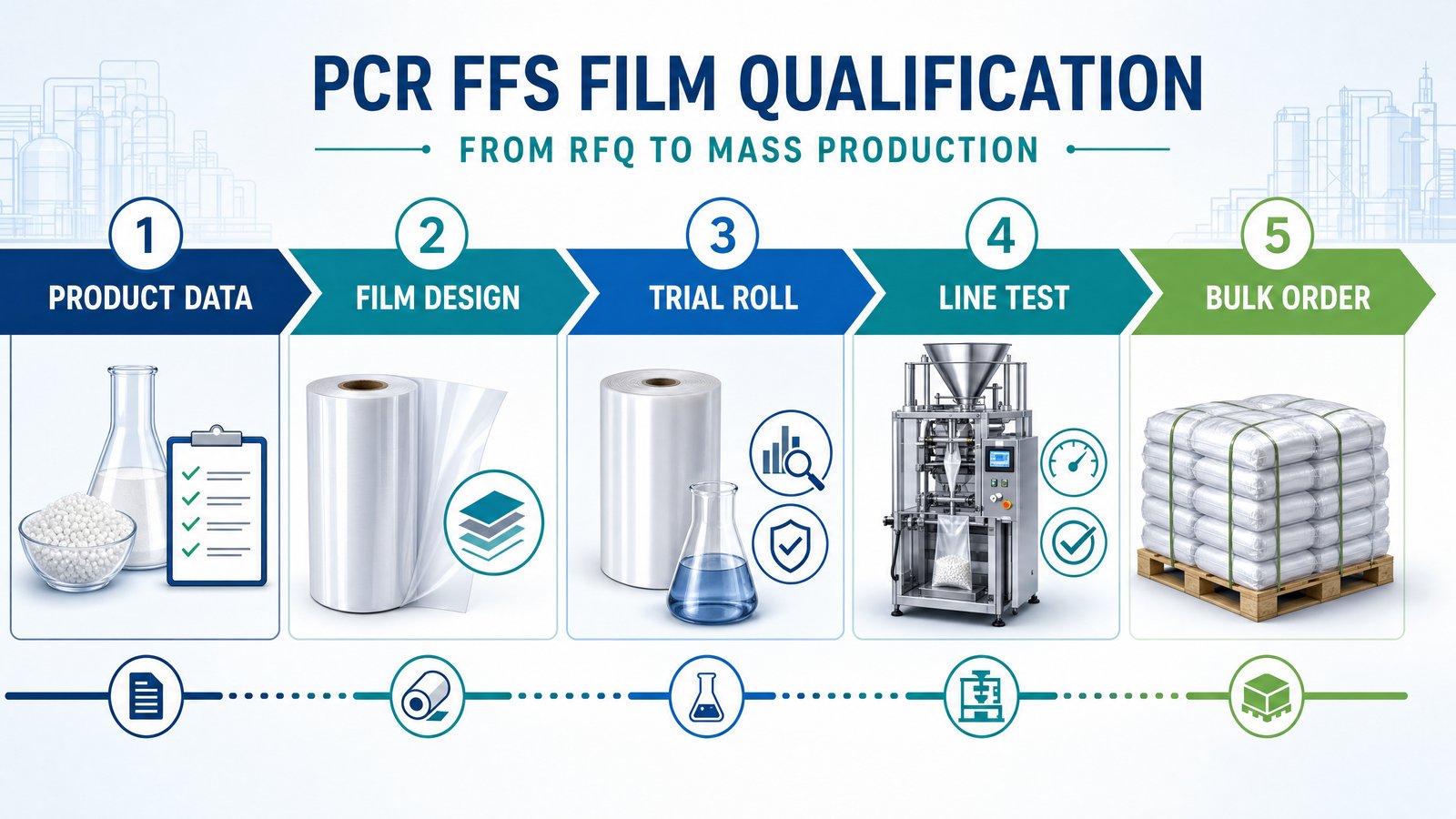
Before placing a bulk order, buyers should request a trial roll or sample structure and test it on the actual production line. Lab data is useful, but FFS packaging is a process. Film behavior on forming shoulders, rollers, sealing jaws, filling stations, and pallets must be confirmed under real operating conditions.

Test item What it verifies Why it matters for PCR FFS film
COF test Film-to-metal and film-to-film friction behavior. Supports smooth unwinding, tracking, and fewer film jams.
Gauge tolerance Consistency of film thickness across the roll. Helps maintain stable roll tension and bag forming.
Seal strength Final seal integrity after cooling. Prevents leaks, open seals, and product loss.
Hot tack Seal strength before the seal fully cools. Critical when product drops immediately after sealing.
Dart impact Resistance to sudden impact. Important for heavy products and rough handling.
Drop test Finished bag performance under handling stress. Validates the full package, not only the film sample.

How Layer Structure Helps Balance PCR and Performance

Adsure’s PCR FFS film uses a three-layer structure that separates the main functions across the film. In this 3-layer PE co-extrusion structure, the outer layer can support stiffness, printability, and surface treatment; the core layer can carry PCR content; and the inner layer can provide sealing performance.

This structure-based design is especially important for 25 kg to 50 kg industrial bags. If the product is abrasive or dense, the three-layer PE structure should be reinforced through thickness, resin selection, PCR placement, sealing-layer optimization, and application testing. If the application is lighter, the same three-layer structure may be optimized for cost efficiency and machineability. In all cases, the target PCR percentage should be confirmed through film testing and line trials.

PCR FFS film qualification workflow from RFQ to trial roll testing and mass production

How Buyers Should Prepare an RFQ for PCR FFS Film

The best way to get a reliable recommendation is to provide complete packaging and machine information at the RFQ stage. Without these details, a supplier can only estimate the PCR percentage. With the right details, the supplier can recommend the film structure, thickness, roll width, roll diameter, core size, COF target, sealing layer, printing method, and testing plan.

RFQ information Why Adsure needs it
Filling product and product photo Identifies puncture, dust, abrasion, and contamination risks.
Packing weight and bag dimensions Determines film thickness, structure, and load-bearing needs.
VFFS or HFFS machine brand and model Helps match roll width, forming collar, tension, and sealing settings.
Current film thickness and structure Provides a baseline for conversion to mono PE and PCR content.
Target PCR percentage Allows Adsure to propose a realistic test path, not only a claim.
Printing artwork and destination market Affects surface treatment, barcode readability, appearance, and EU-market documentation.

Conclusion: Choose PCR FFS Film by Evidence, Not Assumption

PCR FFS film is a practical route for brands and industrial packers that want recyclable mono PE packaging with recycled-content potential. But the right PCR percentage is not determined by a marketing target alone. It must be validated against product weight, puncture risk, seal performance, machine compatibility, printing, color, and shipping conditions.

For buyers converting from standard FFS film or PA/PE laminate structures, Adsure recommends starting with a technical review, then moving to sample development and trial roll testing. If your project requires a recyclable mono PE structure with up to 30% PCR content, contact Adsure to discuss your application, machine model, packing weight, and destination market.

Request a PCR FFS Film Trial Roll »

FAQ: PCR FFS Film Selection

Can every mono PE FFS film use 30% PCR?

No. A mono PE FFS film can be designed with up to 30% PCR when the application, thickness, product weight, printing, color, and performance requirements allow it. Heavy-duty bags, abrasive products, or high-speed FFS lines may need a phased test plan before reaching the highest PCR target.

Does PCR content reduce FFS film strength?

PCR content can affect strength depending on resin quality, percentage, and layer placement. A well-designed PCR FFS film can balance recycled content with puncture resistance, dart impact, and seal performance by using controlled PCR in the core layer and optimized PE layers where needed.

Is PCR FFS film suitable for 25 kg to 50 kg bags?

Yes, it can be suitable for 25 kg to 50 kg applications, but testing is essential. For fertilizer, feed, resin pellets, building materials, and heavy powders, Adsure recommends validating structure, thickness, sealing, drop impact, and pallet stability before bulk production.

Reviewed by: Adsure Packaging Technical Team

Trademark Disclaimer: Autobag®, SidePouch®, and FAS SPRint Revolution™ are trademarks of Automated Packaging Systems, Inc. (a Sealed Air company). Adsure Packaging is not affiliated with, endorsed by, or authorized by Sealed Air Corporation or Automated Packaging Systems. All compatible products are independently manufactured by Adsure Packaging.